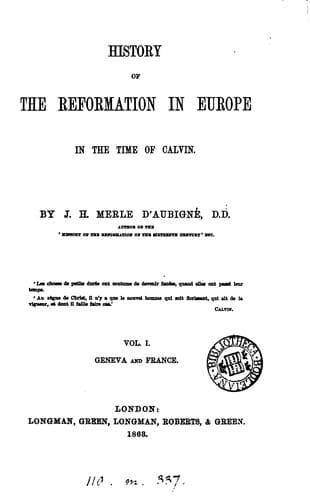
History of the Reformation in Europe in the Time of Calvin, Vol. 8 (of 8)Merle d'Aubigné, J. H. (Jean Henri)
History
History of the Reformation in Europe in the Time of Calvin, Vol. 8 (of 8)
Merle d'Aubigné, J. H. (Jean Henri)
Reformation
Soon after her arrival in the Netherlands it was observed that feelings
to which the cruelty of the Inquisition had given birth in her noble
heart were developing themselves--indignation against the persecutors,
and love for the persecuted. It is known that in these parts were
to be found some of the Vaudois, the Lollards, and the Brethren of
the Common Life, all alike inspired with a true religious spirit.
The fresh information which Joanna now received strengthened her
previous impressions of hostility to Roman superstition. The Catholic
Isabella, alarmed at the reports which reached her, sent to Brussels
the sub-prior of Santa Cruz, Thomas de Matienzo, to see what the facts
were, and to arrest the evil. The princess, who tenderly loved her
mother, was cast down on hearing of her displeasure, and tears started
to her eyes. But her resolution did not give way. The sub-prior took
all possible pains to draw from Joanna some answer to the questions
which Isabella had charged him to ask. He was very coldly received; and
on Assumption Day, when two of the confessors of the princess presented
themselves for the purpose of receiving her confession, she declined
their services in the very presence of her mother's envoy.[202] Her
former tutor, Friar Andrew, who felt much anxiety for the soul of his
pupil, entreated her to dismiss certain Parisian theologians, who
seem to have been more enlightened than the majority of the priests,
but whom Friar Andrew called drunkards. At the same time he begged
the princess to supply their place by taking for her confessor a good
Spanish monk. But all his entreaties were fruitless. Nothing could
overcome the repugnance which she felt towards the Roman religion. On
several occasions she refused its rites, but she did not advance nor
take any active steps. Her strength was passive only.
[Sidenote: BIRTH OF CHARLES THE FIFTH.]
On February 24, 1500, Joanna gave birth to a son, who was to become
the emperor Charles the Fifth. Conspicuous amongst the magnificent
presents offered to the young prince was the gift of the ecclesiastics
of Flanders, who laid before him the New Testament, splendidly bound,
and bearing the inscription in letters of gold--_Search the Scriptures_.
Public-domain text, read in full here on John Shaqi.
Reviews
Reviews
No reviews yet
Be the first to share your thoughts on this work.
Elsewhere in the archive
Join the Discussion
Join the discussion
Sign in to leave a comment or review.
Sign InorCreate an account