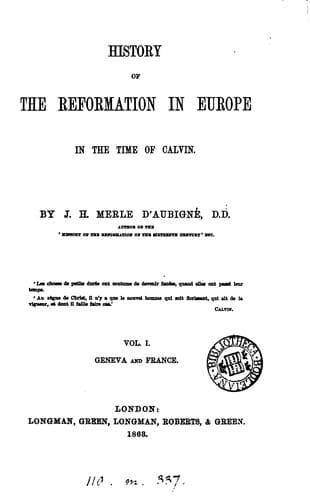
History of the Reformation in Europe in the Time of Calvin, Vol. 8 (of 8)Merle d'Aubigné, J. H. (Jean Henri)
History
History of the Reformation in Europe in the Time of Calvin, Vol. 8 (of 8)
Merle d'Aubigné, J. H. (Jean Henri)
Reformation
In 1504 Isabella died. Ferdinand publicly announced to the people,
assembled in front of the palace of Medina del Campo, that although
the crown belonged to his daughter he should continue to govern during
his lifetime. Joanna and Philip, her husband, were still in the
Netherlands. It appears that Joanna bore with meekness this robbery of
the crown by her father; but it was otherwise with her husband. Philip
energetically protested against this act of spoliation. 'Ferdinand,'
he said, 'has put into circulation a false report of the madness of
his daughter and other absurdities of the like kind, solely with a
view to furnish himself with a pretext for seizing her crown.'[203]
It has generally been stated that it was Philip's mother who had
caused the madness of his widow. But this report, it is evident, was
already in circulation at a time when she had, without contradiction,
the full possession of her reason. We have seen from what source the
report came, and the interest which her father had in causing it to be
believed.
In 1506 Philip, accompanied by Joanna, arrived in Spain for the
purpose of assuming himself the power which his father-in-law had
usurped. The majority of the people soon declared themselves on the
side of Joanna; and Ferdinand, in a fit of anger, was on the point of
encountering his son-in-law with _capa y spada_, intending to plunge
his sword into his bosom. But he observed ere long that a party was
forming, and was becoming more and more numerous, at the head of which
was the constable of Castile, whose object was to set aside both
Philip and Ferdinand, and to place the legitimate queen on the throne.
Ferdinand was perplexed, finding that he had two rivals, his son-in-law
and his daughter. It was clear to him that Joanna, as Infanta and
lawful heiress, would easily win all the hearts of the people, and
that Philip, as a foreigner and usurper, would find it hard to gain
acceptance. He resolved, therefore, to unite with Philip against his
own daughter. He gave him an appointment to meet him at Villafafila,
on June 26 (1506). The king determined to assume an appearance of
amiability. He took with him only a small number of attendants, dressed
himself plainly, mounted an ass, and thus arrived in the presence of
his son-in-law with the air of a gallant country gentleman, an amiable
smile upon his lips, and saying that he came 'with love in his heart
and peace in his hands.' Philip received him attended by a considerable
number of grandees of the Netherlands and of Spain, besides a large
body of men-at-arms. Philip himself, who was surnamed the Handsome, was
in the pride of his youth and strength. Ferdinand having dismounted
from his ass and saluted his son-in-law begged him to follow him alone
into the church. All the members of their suite were forbidden to
accompany the two princes, and guards were stationed at the entrance
to prevent any one from penetrating into the church. There, at the
Public-domain text, read in full here on John Shaqi.
Reviews
Reviews
No reviews yet
Be the first to share your thoughts on this work.
Elsewhere in the archive
Join the Discussion
Join the discussion
Sign in to leave a comment or review.
Sign InorCreate an account