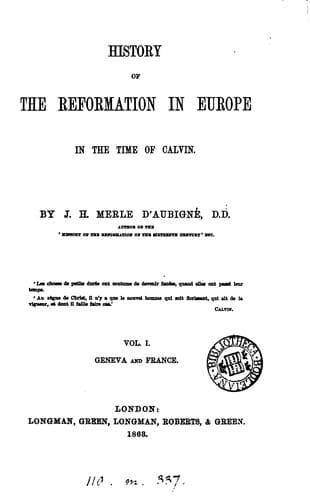
History of the Reformation in Europe in the Time of Calvin, Vol. 8 (of 8)Merle d'Aubigné, J. H. (Jean Henri)
History
History of the Reformation in Europe in the Time of Calvin, Vol. 8 (of 8)
Merle d'Aubigné, J. H. (Jean Henri)
Reformation
The queen was then at Burgos, and it was determined to remove her
thence to Tordesillas, where they intended to keep her in confinement.
Philip had died at Burgos, and his body was to be transferred to
Granada, to be there interred in the sepulchre of the kings. This
involved a journey from the north to the middle of Spain, and
Tordesillas lay on the road. The scheme was to have the queen set out
at the same time as the body of her husband. One and the same escort
would thus serve for both. It has been supposed that there might be
financial reasons for this arrangement. In our days, it has been
said, no one would ever think of such economy. But at that time the
want of money was incessantly obtruding itself, and people might be
well pleased to save a thousand _scudos_.[205] This conjecture is
admissible; but there were other reasons. The journey was made slowly.
On two or three occasions the queen was removed from one place to
another by night. But it is of little moment whether the journey from
Burgos to Tordesillas was made by night or by day. In any case it was a
strange spectacle, the grand funeral car, with its dismal but splendid
accompaniments, and after these the carriages of the captive queen,
about whom the most extraordinary reports were already in circulation.
It has been stated that the death of Philip had cost Joanna the loss
of her reason; it has been said that she had so much affection for her
husband that she wished to have his body always near her, as if it
were still living; that she was jealous even of her dead husband, and
would not allow her women to approach his corpse.[206] It was rumored
at the time that the queen, watching for the moment of his return to
life, refused to be separated from the lifeless body; and this very
journey was referred to as an irrefragable proof of her madness. But
these allegations are belied by facts. As the tomb at Granada was not
yet ready, the body of Philip remained for several years in the convent
of St. Clara at Tordesillas, and the queen did not once go to see it
nor did she even express a wish to do so. She used to speak of Philip
as any faithful wife would speak of her deceased husband. Her excessive
tenderness for Philip, who had behaved infamously towards her, her
resolution never to be separated from his corpse--these are fables of
modern history, invented by those who were determined to deprive her of
her rights and to thrust themselves into her place.
[Sidenote: JOANNA AT TORDESILLAS.]
Public-domain text, read in full here on John Shaqi.
Reviews
Reviews
No reviews yet
Be the first to share your thoughts on this work.
Elsewhere in the archive
Join the Discussion
Join the discussion
Sign in to leave a comment or review.
Sign InorCreate an account