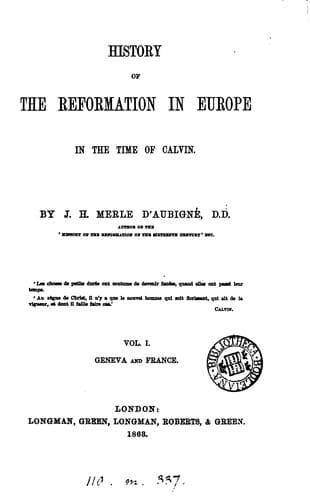
History of the Reformation in Europe in the Time of Calvin, Vol. 8 (of 8)Merle d'Aubigné, J. H. (Jean Henri)
History
History of the Reformation in Europe in the Time of Calvin, Vol. 8 (of 8)
Merle d'Aubigné, J. H. (Jean Henri)
Reformation
Much admiration was likewise felt for Bullinger. We confess ourselves
to be entirely yours, wrote to him the four Englishmen, 'as long as
we can be our own.' The works of the Zurich doctor were much read in
England, and diffused there the spirit of the Gospel. Nicolas Eliot
wrote to him:--'And how great weight all persons attribute to your
commentaries, how greedily they embrace and admire them (to pass over
numberless other arguments), the booksellers are most ample witnesses
whom by the sale of your writings alone, from being more destitute than
Irus and Codrus, you see suddenly become as rich as Crœsus.[225] May
God, therefore, give you the disposition to publish all your writings
as speedily as possible, whereby you will not only fill the coffers
of the booksellers, but will gain over very many souls to Christ, and
adorn his church with most precious jewels.'[226]
[Sidenote: WORKS OF BULLINGER.]
At the news that the mighty king of England had separated from the
pope, the Swiss theologians were filled with hope, and they vied with
each other in speeding his progress towards the truth. Bullinger
composed two works in Latin which he dedicated to Henry VIII.; the
first of them on _The Authority, the Certitude, the Stability and the
Absolute Perfection of Holy Scripture_; the second on _The Institution
and the Function of Bishops_. He forwarded copies of these works to
Partridge and Eliot for presentation to the king, to Cranmer, and to
Cromwell. The two young Englishmen went first to the archbishop and
delivered to him the volumes intended for the king and for himself. The
archbishop consented to present the book to the prince, but not till
after he had read it himself, and on condition that Eliot and Partridge
should be present, that they might answer any questions asked by the
king. Then going to Cromwell, they gave him the copy intended for him;
and the viceregent, more prompt than the archbishop, showed it the
same day to Henry VIII., to whom Cranmer then hastened to present his
own copy. The king expressed a wish that the work should be translated
into English. 'Your books are wonderfully well received,' wrote Eliot
to Bullinger, 'not only by our king, but equally so by the lord
Cromwell, who is keeper of the king's privy seal and vicar-general of
the church of England.'[227]
Public-domain text, read in full here on John Shaqi.
Reviews
Reviews
No reviews yet
Be the first to share your thoughts on this work.
Elsewhere in the archive
Join the Discussion
Join the discussion
Sign in to leave a comment or review.
Sign InorCreate an account