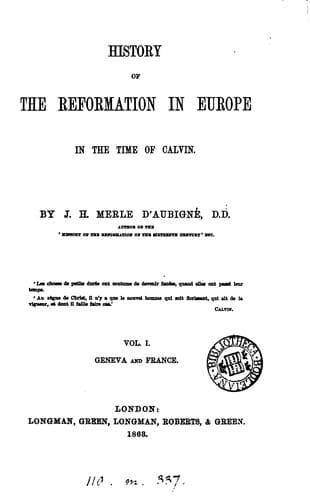
History of the Reformation in Europe in the Time of Calvin, Vol. 8 (of 8)Merle d'Aubigné, J. H. (Jean Henri)
History
History of the Reformation in Europe in the Time of Calvin, Vol. 8 (of 8)
Merle d'Aubigné, J. H. (Jean Henri)
Reformation
The summer was now drawing to an end. The German delegates had been in
London three or four months without having made any progress. Wearied
with fruitless discussions, they began to think of their departure.
But before setting out, about the middle of August, they forwarded
to the king a document in which they argued from Holy Scripture,
from the testimony of the most ancient of the Fathers, and from the
practice of the primitive church, against the withdrawal of the cup,
private masses, and the celibacy of priests, three errors which they
looked upon as having essentially contributed to the deformation of
Christendom. When Cranmer heard of their intention to leave England, he
was much affected. Their departure dissipated all his hopes. Must he
then renounce the hope of seeing the Word of God prevail in England as
it was prevailing in evangelical Germany? He summoned them to Lambeth,
and entreated them earnestly and with much kindliness[248] for the
king's sake to remain. They replied 'that at the king's request they
would be very well content to tarry during his pleasure, not only a
month or two, but a year or two, if they were at their own liberty.
But forasmuch they had been so long from their princes, and had not
all this season any letters from them, it was not to be doubted but
that they were daily looked for at home, and therefore they durst not
tarry.' However, after renewed entreaties, they said, 'We will consult
together.' They discussed with one another the question whether they
ought to leave England just at the time when she was perhaps on the
point of siding with the truth. Shall we refuse to sacrifice our
private convenience to interests so great? They adopted the least
convenient but most useful course. We will tarry, they said, for a
month, 'upon hope that their tarrying should grow into some good
success concerning the points of their commission,' and 'trusting that
the king's majesty would write unto their princes for their excuse in
thus long tarrying.' The evangelicals of Germany believed it to be
their duty to tolerate certain secondary differences, but frankly to
renounce those errors and abuses which were contrary to the essential
doctrines of the Gospel, and to unite in the great truths of the faith.
This was precisely what the Catholic party and the king himself had no
intention of doing. When Cranmer urged the bishops to apply themselves
to the task of answering the Germans, they replied 'that the king's
grace hath taken upon himself to answer the said orators in that
behalf ... and therefore they will not meddle with the abuses lest they
should write therein contrary to that the king shall write.'[249] It
was, indeed, neither pleasant nor safe to contradict Henry VIII. But in
this case the king's opinion was only a convenient veil, behind which
the bishops sought to conceal their ill-will and their evil doctrines.
Their reply was nothing but an evasion. The book was written, not by
Public-domain text, read in full here on John Shaqi.
Reviews
Reviews
No reviews yet
Be the first to share your thoughts on this work.
Elsewhere in the archive
Join the Discussion
Join the discussion
Sign in to leave a comment or review.
Sign InorCreate an account