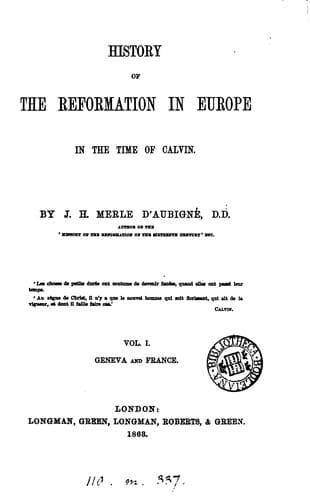
History of the Reformation in Europe in the Time of Calvin, Vol. 8 (of 8)Merle d'Aubigné, J. H. (Jean Henri)
History
History of the Reformation in Europe in the Time of Calvin, Vol. 8 (of 8)
Merle d'Aubigné, J. H. (Jean Henri)
Reformation
The Romish party in England did not confine itself to preventing
the union of Henry with the Protestants of Germany; but contended
at all points against evangelical reformation, and strove to gain
over the king by a display of enthusiastic devotion to his person
and his ecclesiastical supremacy. This was especially the policy of
Gardiner. Endowed with great acuteness of intellect, he had studied
the king's character, and he put forth all his powers to secure his
adoption of his own views. Henry did not esteem his character, but
highly appreciated his talents, and on this account employed him.
Now Gardiner was the mainstay of the Scholastic doctrines and the
most inflexible opponent of the Reformation. He was for three years
ambassador in France, and during that mission he had displayed great
pomp and spent a sum equivalent, in our present reckoning, to about
sixty thousand pounds. He had visited the court of the emperor, and
had had interviews with the Roman legate. One day, at Ratisbon, an
Italian named Ludovico, a servant of the legate, while talking with one
of the attendants of Sir Henry Knevet, who was a member of the English
embassy, had confided to him the statement that Gardiner had secretly
been reconciled with the pope, and had entered into correspondence with
him. Knevet, exceedingly anxious to know what to think of it, had had
a conference with Ludovico, and had come away convinced of the reality
of the fact. No sooner did Gardiner get wind of these things, then he
betook himself to Granvella, chancellor of the empire, and sharply
complained to him of the calumnies of Ludovico. The chancellor ordered
the Italian to be put in prison; but in spite of this measure many
continued to believe that he had spoken truth. We are inclined to think
that Ludovico said more than he knew. The story, however, indicates
from which quarter the wind was blowing in the sphere in which Gardiner
moved. He had set out for Paris on October 1, 1535; and on September
28, 1538, there was to be seen entering London a brilliant and numerous
band, mules and chariots hung with draperies on which were embroidered
the arms of the master, lackeys, gentlemen dressed in velvet, with many
ushers and soldiers. This was Gardiner and his suite.[253]
Public-domain text, read in full here on John Shaqi.
Reviews
Reviews
No reviews yet
Be the first to share your thoughts on this work.
Elsewhere in the archive
Join the Discussion
Join the discussion
Sign in to leave a comment or review.
Sign InorCreate an account