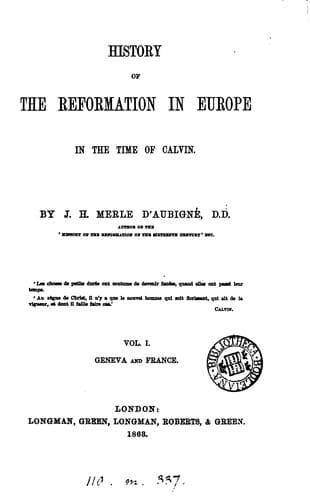
History of the Reformation in Europe in the Time of Calvin, Vol. 8 (of 8)Merle d'Aubigné, J. H. (Jean Henri)
History
History of the Reformation in Europe in the Time of Calvin, Vol. 8 (of 8)
Merle d'Aubigné, J. H. (Jean Henri)
Reformation
The king then turning to Cranmer commanded him to refute the opinion
of the accused. The archbishop spoke with modesty, calling Lambert
'brother,' and although refuting his arguments he told him that if he
proved his opinion from Holy Scripture, he (Cranmer) would willingly
embrace it. Gardiner, finding that Cranmer was too weak, began to
speak. Tonstall and Stokesley followed. Lambert had put forward ten
arguments, and ten doctors were appointed to deal with them, each
doctor to impugn one of them. Of the whole disputation the passage
which made the deepest impression on the assembly was Stokesley's
argument. 'It is the doctrine of the philosophers,' he said, 'that
a substance can not be changed but into a substance.' Then, by the
example of water boiling on the fire, he affirmed the substance of
the water to pass into the substance of the air.[272] On hearing
this argument, the aspect of the bishops, hitherto somewhat uneasy,
suddenly changed. They were transported with joy, and considered this
transmutation of the elements as giving them the victory, and they cast
their looks over the whole assembly with an air of triumph. Loud shouts
of applause for some time interrupted the sitting. When silence was at
length restored, Lambert replied that the moistness of the water, its
real essence, remained even after this transformation; that nothing
was changed but the form; while in their system of the _corpus domini_
the substance itself was changed; and that it is impossible that the
qualities and accidents of things should remain in their own nature
apart from their own subject. But Lambert was not allowed to finish
his refutation. The king and the bishops, indignant that he ventured
to impugn an argument which had transported them with admiration, gave
vent to their rage against him,[273] so that he was forced to silence,
and had to endure patiently all their insults.
[Sidenote: CONDEMNATION OF LAMBERT.]
The sitting had lasted from noon till five o'clock in the evening. It
had been a real martyrdom for Lambert. Loaded with rebukes and insults,
intimidated by the solemnity of the proceedings and by the authority
of the persons with whom he had to do, alarmed by the presence of the
king and by the terrible threats which were uttered against him, his
body too, which was weak before, giving way under the fatigue of a
sitting of five hours, during which, standing all the time, he had been
compelled to fight a fierce battle, convinced that the clearest and
most irresistible demonstrations would be smothered amidst the outcries
of the bystanders, he called to mind these words of Scripture, 'Be
still,' and was silent. This self-restraint was regarded as defeat.
Where is the knowledge so much boasted of? they said; where is his
power of argumentation? The assembly had looked for great bursts of
eloquence, but the accused was silent. The palm of victory was awarded
to the king and the bishops by noisy and universal shouts of applause.
Public-domain text, read in full here on John Shaqi.
Reviews
Reviews
No reviews yet
Be the first to share your thoughts on this work.
Elsewhere in the archive
Join the Discussion
Join the discussion
Sign in to leave a comment or review.
Sign InorCreate an account