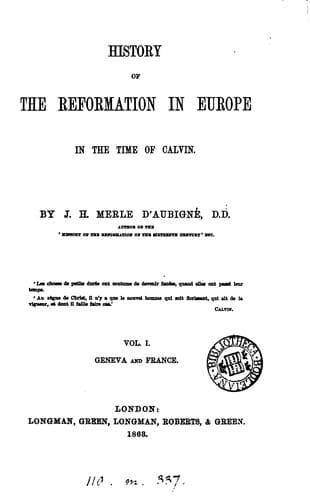
History of the Reformation in Europe in the Time of Calvin, Vol. 8 (of 8)Merle d'Aubigné, J. H. (Jean Henri)
History
History of the Reformation in Europe in the Time of Calvin, Vol. 8 (of 8)
Merle d'Aubigné, J. H. (Jean Henri)
Reformation
Shortly after the king's arrival at Greenwich, Cromwell, the promoter
of this unfortunate affair, presented himself to his majesty, not
without fear, and inquired how he liked the lady Anne. The king
replied,--'Nothing so well as she was spoken of. Had I known as much
before as I do now, she should not have come within this realm.' Then,
with a deep sigh, he exclaimed, 'What remedy?'[310] 'I know none,'
said Cromwell, 'and I am very sorry therefor.' The agents of the
king had given proof neither of intelligence nor of integrity in the
matter. Hutton, who had written to Cromwell that the princess was not
beautiful, and Southampton, who had had a good view of her at Calais,
had both spoken to the king only of her beauty. On the following day
Anne arrived at Greenwich; the king conducted her to the apartment
assigned to her, and then retired to his own very melancholy and in an
ill humor. Cromwell again presented himself. 'My lord,' said the king,
'say what they will, she is nothing so fair as she hath been
reported ... howbeit, she is well and seemly.' 'By my faith, sir,'
replied Cromwell, 'ye say truth; but I think she has a queenly manner.'
'Call together the council,' said Henry.
The princess made her entry into London in great pomp, and appeared at
the palace. The court had heard of Henry's disappointment and was in
consternation. 'Our king,' they said, 'could never marry such a queen.'
In default of speech, music would have been a means of communication;
it speaks and moves. Henry and his courtiers were passionately fond
of it; but Anne did not know a single note. She knew nothing but the
ordinary occupations of women. In vain did Cromwell venture to say
to his master that she had, nevertheless, a portly and fine person.
Henry's only thought was how to get rid of her. The marriage ceremony
was deferred for a few days. The council took into consideration the
question whether certain projects of union between Anne and the son
of the duke of Lorraine did not form an obstacle to her marriage with
Henry. But they found here no adequate ground of objection. 'I am
not well treated,' the king said to Cromwell. Many were afraid of a
rupture. The divorce between Henry and Catherine, the cruelty with
which he had treated the innocent Anne Boleyn, had already given rise
to so much discontent in Europe that people dreaded a fresh outbreak.
The cup was bitter, but he must drink it. The 6th of January was
positively fixed for the fatal nuptials. The king was heard the day
before murmuring in a low tone with an accent of despair,--'It must be;
it must be,' and presently after, 'I will put my neck under the yoke.'
He determined to live in a becoming way with the queen. An insuperable
antipathy filled his heart, but courteous words were on his lips. In
the morning the king said to Cromwell,--'If it were not for the great
preparations that my states and people have made for her, and for fear
Public-domain text, read in full here on John Shaqi.
Reviews
Reviews
No reviews yet
Be the first to share your thoughts on this work.
Elsewhere in the archive
Join the Discussion
Join the discussion
Sign in to leave a comment or review.
Sign InorCreate an account