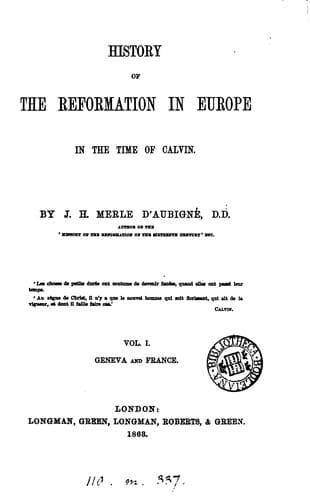
History of the Reformation in Europe in the Time of Calvin, Vol. 8 (of 8)Merle d'Aubigné, J. H. (Jean Henri)
History
History of the Reformation in Europe in the Time of Calvin, Vol. 8 (of 8)
Merle d'Aubigné, J. H. (Jean Henri)
Reformation
But the Protestantism of the king of England was displayed not
so much in matters of faith as in public affairs. He showed much
irritation against the emperor; and this gave rise to a characteristic
conversation. Henry having instructed (January, 1540) his ambassador
in the Netherlands, Sir Thomas Wyatt, to make certain representations
and demands on various subjects which concerned his government, '_I
shall not interfere_,' drily replied the grand potentate. Wyatt having
further made complaint that the English merchants in Spain were
interfered with by the Inquisition, the emperor laconically answered
that he knew nothing about it, and referred him to Granvella. Wyatt
then having been so bold as to remark that the monarch answered him in
an ungracious manner,[315] Charles interrupted him and said that he
'abused his words toward him.' But the ambassador, who meant exactly
to carry out his master's orders, did not stop, but uttered the word
ingratitude. Henry considered Charles ungrateful on the ground that he
had greatly obliged him on one important occasion. In fact, the emperor
Maximilian having offered to secure the empire for the king of England,
the thought of encircling his brows with the crown of the Roman
emperors inflamed the ardent imagination of the young prince, who was
an enthusiast for the romantic traditions of the Middle Ages. But,
after the death of Maximilian, the Germans decided in favor of Charles.
The latter then came to England, and the two kings met. Not very much
is known of what they said in their interview; but whatever it might
be, Henry yielded, and he believed that to his generosity Charles was
indebted for the empire. '_Ingratitude!_' replied the emperor to the
ambassador. 'From whom mean you to proceed that ingratitude?... I would
ye knew I am not ingrate, and if the king your master hath done me a
good turn I have done him as good or better. And I take it so, that
I can not be toward him ingrate; the inferior may be ingrate to the
greater. But peradventure because the language is not your natural
tongue, ye may mistake the term.' 'Sir,' replied Wyatt, 'I do not know
that I misdo in using the term that I am commanded.' The emperor was
much moved. 'Monsieur l'ambassadeur,' he said, 'the king's opinions
be not always the best.' 'My master,' Wyatt answered, 'is a prince
to give reason to God and to the world sufficient in his opinions.'
'It may be,' Charles said coolly.[316] His intentions were evidently
becoming more and more aggressive. Henry VIII. clearly perceived what
his projects were. 'Remember,' said the king the same month to the duke
of Norfolk, whom he had sent as envoy extraordinary to France, 'that
Charles has it in his head to bring Christendom to a monarchy.[317] For
if he be persuaded that he is a superior to all kings, then it is not
to be doubted that he will by all ways and means ... cause all those
whom he so reputeth for his inferiors to acknowledge his superiority in
Public-domain text, read in full here on John Shaqi.
Reviews
Reviews
No reviews yet
Be the first to share your thoughts on this work.
Elsewhere in the archive
Join the Discussion
Join the discussion
Sign in to leave a comment or review.
Sign InorCreate an account