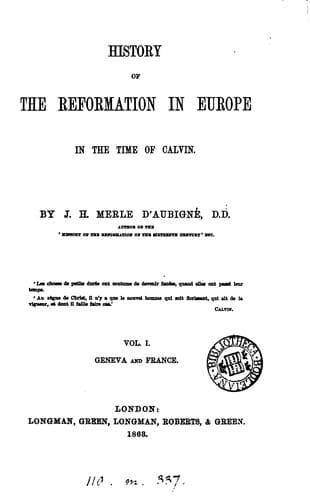
History of the Reformation in Europe in the Time of Calvin, Vol. 8 (of 8)Merle d'Aubigné, J. H. (Jean Henri)
History
History of the Reformation in Europe in the Time of Calvin, Vol. 8 (of 8)
Merle d'Aubigné, J. H. (Jean Henri)
Reformation
At the same time that Henry VIII. was imprisoning the ministers of
God's Word, he was giving full liberty to the Word itself. It must be
confessed that in his conflict with the pope he did make use of the
Bible. He interpreted it, indeed, in his own way; but still he used
it and helped to circulate it. This was a fact of importance for the
Reformation in England. The first Bible named after Cranmer appeared at
this time (April, 1540), with a preface by the archbishop, in which he
called upon 'high and low, male and female, rich and poor, master and
servant, to read it and to meditate upon it in their own houses.'[327]
A magnificent copy on vellum was presented to the king. In the same
month appeared another Bible, printed in smaller type; in July another
great Bible; in November a third in folio, authorized by Henry
VIII., 'supreme head of his church.' It would seem even that there
was one more edition this year. At all events, the New Testament was
printed.[328] The enemies of the Bible were in power. Nevertheless the
Bible was gaining the victory; and the luminary which was to enlighten
the world was beginning to shed abroad its light everywhere.
CHAPTER V.
DISGRACE AND DEATH OF CROMWELL, EARL OF ESSEX.
(1540.)
Eight days after the imprisonment of Barnes and his two friends (April
12, 1540), parliament opened for the first time without abbots or
priors. Cromwell was thoughtful and uneasy; he saw everywhere occasions
of alarm; he felt his position insecure. The statute of the Six
Articles, the conviction which possessed his mind that the doctrines
of the Middle Ages were regaining an indisputable ascendency over the
king, the wrath of Norfolk, and Henry's ill-will on account of the
queen whom Cromwell had chosen for him--these were the dark points
which threatened his future. His friends were scattered or persecuted;
his enemies were gathered about the throne. Henry, however, made no
sign, but secretly meditated a violent blow. He concealed the game he
was playing so that others, and especially Cromwell himself, should
have no perception of it. The powerful minister, therefore, appeared
in parliament, assuming a confident air, as the ever-powerful organ
of the supreme will of the king. Henry VIII., the man of extremes,
thought proper at this time to exhibit himself as an advocate of a
middle course. The country is agitated by religious dissensions, said
the vicegerent, his representative; and in his speech to the House
he set forth on the one hand the rooted superstition and obstinate
clinging to popery, and on the other thoughtless and impertinent and
culpable rashness (referring doubtless to Barnes): that the king
desired a union of the two parties; that he leaned to neither side;
that he would equally repress the license of heretics and that of the
papists, and that he 'set the pure and sincere doctrine of Christ
Public-domain text, read in full here on John Shaqi.
Reviews
Reviews
No reviews yet
Be the first to share your thoughts on this work.
Elsewhere in the archive
Join the Discussion
Join the discussion
Sign in to leave a comment or review.
Sign InorCreate an account