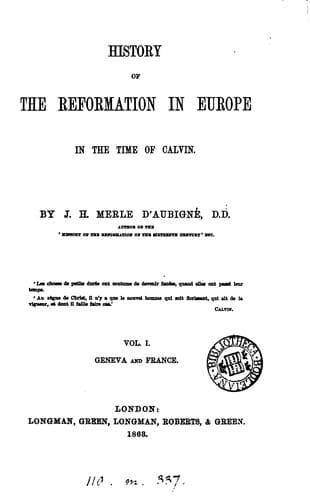
History of the Reformation in Europe in the Time of Calvin, Vol. 8 (of 8)Merle d'Aubigné, J. H. (Jean Henri)
History
History of the Reformation in Europe in the Time of Calvin, Vol. 8 (of 8)
Merle d'Aubigné, J. H. (Jean Henri)
Reformation
Would Cromwell then, after all, escape? Those who were ignorant of what
was passing at court looked upon it as impossible that he should be
sacrificed so long as Anne of Cleves was queen of England. But the very
circumstances which seemed to them the guarantee of his safety were to
be instead the occasion of his ruin.
Henry's dislike to his wife was ever increasing, and he was determined
to get rid of her. But, as usual, he concealed beneath flowers the
weapon with which he was about to strike her. In the month of March,
the king gave, in honor of the queen, a grand fête with a tournament,
as he had done for Anne Boleyn; and amongst the numerous combatants,
who took part in the jousting were Sir Thomas Seymour, the earl of
Sussex, Harry Howard, and Richard Cromwell, nephew of the earl of
Essex, and ancestor of the great Protector Oliver.[348]
[Sidenote: CATHERINE HOWARD.]
One circumstance contributed to hasten the decision of the king.
There was at the court a young lady, small of stature, of a good
figure and beautiful countenance, of ladylike manners, coquettish and
forward, who at this time made a deep impression on Henry. This was
Catherine Howard, a niece of the duke of Norfolk, now residing with
her grandmother, the duchess-dowager, who allowed her great liberty.
Katherine was in every respect a contrast to Anne of Cleves. Henry
resolved to marry her, and for this purpose to get rid forthwith of
his present wife. As he was desirous of being provisionally relieved
of her presence, he persuaded her that a change of air would be very
beneficial to her, and that it was necessary that she should make
a stay in the country. On June 24 he sent the good princess, who
felt grateful for his attentions, to Richmond. At the same time he
despatched the bishop of Bath to her brother, the duke of Cleves,
with a view to prepare him for the very unexpected decision which was
impending over his sister, and to avert any vexatious consequences.[349]
Cromwell, then, had no aid to look for at the hands of a queen already
forsaken and ere long repudiated. He could not hope to escape death.
His enemies were urgent for the execution of the bill. They professed
to have discovered a correspondence which he had carried on with the
Protestant princes of Germany.[350]
Public-domain text, read in full here on John Shaqi.
Reviews
Reviews
No reviews yet
Be the first to share your thoughts on this work.
Elsewhere in the archive
Join the Discussion
Join the discussion
Sign in to leave a comment or review.
Sign InorCreate an account