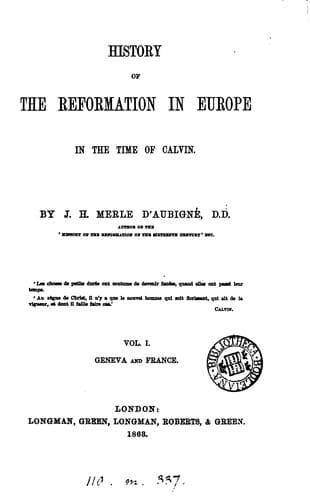
History of the Reformation in Europe in the Time of Calvin, Vol. 8 (of 8)Merle d'Aubigné, J. H. (Jean Henri)
History
History of the Reformation in Europe in the Time of Calvin, Vol. 8 (of 8)
Merle d'Aubigné, J. H. (Jean Henri)
Reformation
It is, moreover, no wonder that there should still have been martyrs.
The queen, indeed, was friendly to their cause; but political
circumstances were not favorable. After forty years' alliance with
France, Henry VIII. was about to declare war against that kingdom. The
pretexts for this course were many. The first was the alliance of the
king of France with the Turks, 'who are daily advancing to destroy
and ruin our holy faith and religion, to the great regret of all good
Christians,' said the Council.[427] A second pretext was that the sums
of money which France was bound to pay annually to the king had fallen
in arrear for nine years; there was also the question of the subsidies
granted by France to Scotland during the war between Henry VIII. and
the Scots; the reception and protection of English rebels by Francis
I.; and the detention in French ports of faithful subjects of the king,
merchants and others, with their ships and merchandise. In the despatch
which we have just cited, the king also declared that, if within twenty
days the grievances set forth were not redressed, he should claim the
kingdom of France unjustly held by Francis I. The French ambassador
replied in a conciliatory manner. Diplomacy made no reference to other
grounds of complaint of a more private character, which perhaps throw
light upon those which occasioned the rupture. Francis I. had jested
about the way in which Henry VIII. dealt with his wives. Henry had
sought the hand of French princesses, and they had no mind for this
foreign husband; and lastly, Francis did not fulfil the promise which
he had made to separate from Rome. There were many other pretexts
besides, more or less reasonable, which determined the king to invade
France.
While withdrawing from alliance with Francis I., Henry could not but
at the same time enter into closer relation with Charles V. This
reconciliation seemed natural, for the king of England was really, in
respect to religion, more in harmony with the emperor than with the
Protestants of Germany, whose alliance he had for some time desired.
But Charles required first of all that the legitimacy and the rights of
his cousin, the princess Mary, should be acknowledged; and this Henry
refused to do, because it would have involved an acknowledgment of
his injustice to Catherine of Aragon. A solution which satisfied the
emperor was ultimately devised. It was provided by Act of Parliament
that if Prince Edward should die without children, 'the crown should
go to the lady Mary.'[428] But in this Act no mention was made of her
legitimacy. The result of the concession of this point to Charles V.
was to bring on England a five years' bloody persecution, and to give
her people Philip II. for their king. In default of any issue of Mary,
Elizabeth was to succeed to the throne. After the passing of this Act,
in March, 1543, a treaty of alliance was concluded between England and
the Empire.
Public-domain text, read in full here on John Shaqi.
Reviews
Reviews
No reviews yet
Be the first to share your thoughts on this work.
Elsewhere in the archive
Join the Discussion
Join the discussion
Sign in to leave a comment or review.
Sign InorCreate an account