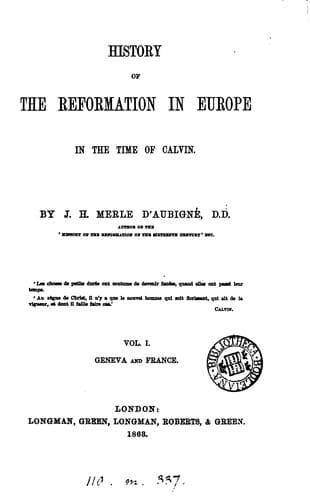
History of the Reformation in Europe in the Time of Calvin, Vol. 8 (of 8)Merle d'Aubigné, J. H. (Jean Henri)
History
History of the Reformation in Europe in the Time of Calvin, Vol. 8 (of 8)
Merle d'Aubigné, J. H. (Jean Henri)
Reformation
Shaxton, having resigned his see of Salisbury after the publication
of the Six Articles, had been put in prison, and had long rejected
all proposals of recantation addressed to him. Having aggravated his
offence while in prison by asserting that the natural body of Christ
was not in the sacrament, he was condemned to be burnt. The bishops of
London and Worcester, sent by the king, visited him in the prison and
strove to convince him. This feeble and egotistic man readily professed
himself persuaded, and thanked the king 'for that he had delivered him
at the same time from the temporal and from the everlasting fire.' On
July 13, 1546, he was set at liberty. As he grew old his understanding
became still weaker; and in Mary's reign the unhappy man was one of the
most eager to burn those whom he had called his brethren.[433]
While there were men like Shaxton, whose fall was decisive and final,
others were to be met with who, although in their own hearts decided
for the truth, were alarmed when they found themselves in danger of
death, and subscribed the Catholic declarations which were offered to
them. But after having thus plunged into the abyss, they lifted up
their heads as soon as possible and again confessed the truth. One
of this class was Edward Crome, who, at this period, gave way on two
occasions, but recovered himself.[434]
Many other blemishes were visible in the general state of the Anglican
church; and the obstinacy of the king, in particular, in maintaining
in his kingdom, side by side, two things in opposition to each other,
the Catholic doctrines and the reading of the Bible, subjected the
sacred volume to strange honors. The king in person prorogued the
parliament on December 24, and on this occasion made his last speech
to the highest body in the state. He spoke as vicar of God, and gave
a lecture to the ministers and the members of the church. It was his
taste; he believed that he was born for this position, and there was in
his nature as much of the preceptor as of the king. Moreover, there was
nothing which offended him so much as the attempt to address a lecture
to himself. Any one who did so risked his own life. But while he was
easily hurt, he did not shrink from hurting the feelings of others. He
handled the rod more easily than the sceptre.
[Sidenote: SPEECH OF HENRY VIII.]
Public-domain text, read in full here on John Shaqi.
Reviews
Reviews
No reviews yet
Be the first to share your thoughts on this work.
Elsewhere in the archive
Join the Discussion
Join the discussion
Sign in to leave a comment or review.
Sign InorCreate an account