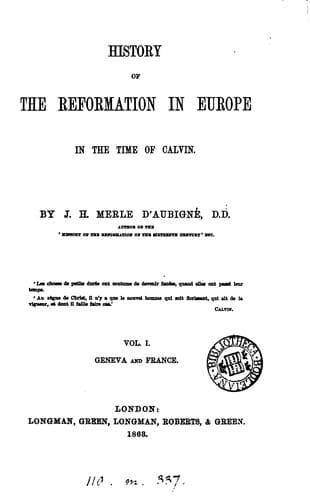
History of the Reformation in Europe in the Time of Calvin, Vol. 8 (of 8)Merle d'Aubigné, J. H. (Jean Henri)
History
History of the Reformation in Europe in the Time of Calvin, Vol. 8 (of 8)
Merle d'Aubigné, J. H. (Jean Henri)
Reformation
and tavern, contrary to the true meaning and doctrine of the same....
Be in charity one with another, ... to the which I, as your supreme
head and sovereign lord, exhort and require you; and then I doubt not
but that love and league, which I spake of in the beginning, shall
never be dissolved or broken between us.'[435]
The school-master had not spoken amiss. The parliament did not make
the retort, 'Physician, heal thyself,' though it might have been
applicable. One of the measures by which the king manifested his 'sweet
charity' proves that, if he were not, like some old school-masters, a
tyrant of words and syllables, he tyrannized over the peace and the
lives of his people.
[Sidenote: ANNE ASKEW.]
There were at the court a certain number of ladies of the highest rank
who loved the Gospel--the duchess of Suffolk, the countess of Sussex,
the countess of Hertford, Lady Denny, Lady Fitzwilliam,[436] and
above all the queen. Associated with these was a pious, lively, and
beautiful young lady, of great intelligence and amiable disposition,
and whose fine qualities had been improved by education. Her name
was Anne Askew. She was the second daughter of Sir William Askew,
member of a very ancient Lincolnshire family. She had two brothers
and two sisters. Her brother Edward was one of the king's bodyguards.
The queen frequently received Anne and other Christian women in her
private apartments; and there prayer was made and the Word of God
expounded by an evangelical minister. The king, indeed, was aware of
these secret meetings, but he feigned ignorance. Anne was at this
time in great need of the consolations of the Gospel. Her father, Sir
William, had a rich neighbor named Kyme, with whom he was intimate;
and being anxious that his eldest daughter should marry a rich man, he
arranged with Kyme that she should wed his eldest son. The young lady
died before the nuptials took place; and Sir William, reluctant to let
slip so good a chance, compelled his second daughter Anne to marry
the betrothed of her sister, and by him she became the mother of two
children. The third sister, Joan, was married to Sir John Saint-Paul.
The Holy Scriptures in the English version attracted Anne's attention,
and ere long she became so attached to them that she meditated on
them day and night. Led by them to a living faith in Jesus Christ,
she renounced Romish superstitions. The priests, who were greatly
annoyed, stirred up against her her young husband, a rough man and
a staunch papist, who 'violently drove her out of his house.'[437]
Anne said, 'Since, according to the Scripture, "if the unbelieving
depart, let him depart. A brother or a sister is not under bondage in
such cases,"[438]--I claim my divorce.' She went to London to take
the necessary proceedings; and either through her brother, one of the
guards, or otherwise, made the acquaintance of the pious ladies of the
court and of the queen herself.
Public-domain text, read in full here on John Shaqi.
Reviews
Reviews
No reviews yet
Be the first to share your thoughts on this work.
Elsewhere in the archive
Join the Discussion
Join the discussion
Sign in to leave a comment or review.
Sign InorCreate an account