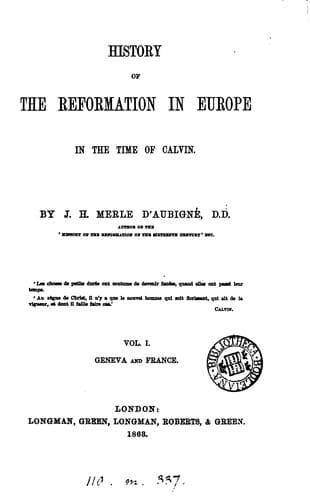
History of the Reformation in Europe in the Time of Calvin, Vol. 8 (of 8)Merle d'Aubigné, J. H. (Jean Henri)
History
History of the Reformation in Europe in the Time of Calvin, Vol. 8 (of 8)
Merle d'Aubigné, J. H. (Jean Henri)
Reformation
Anne was sent back to prison. She was very ill, and believed herself
to be near death. Never had she had to endure such attacks. She
requested leave to see Latimer, who was still confined in the Tower;
but this consolation was not allowed her. Resting firmly, as she
did, on Scriptural grounds, she did not suffer herself to swerve.
To her constitutional resolution she added that which was the fruit
of communion with God; and she was thus placed by faith above the
attacks which she experienced. Having a good foundation, she resolutely
defended the freedom of her conscience and her full trust in Christ;
and not only did she encounter her enemies without wavering, but
she spoke to them with a power sufficient to awe them, and gave
home-thrusts which threw them into confusion. Nevertheless she was
only a weak woman, and her bodily strength began to fail. In Newgate
she said,--'The Lord strengthen us in the truth. Pray, pray, pray.'
She composed while in prison some stanzas which have been pronounced
extraordinary, not only for simple beauty and sublime sentiment, but
also for the noble structure and music of the verse.[440]
By law, Anne had a right to be tried by jury; but on June 28, 1546,
she was condemned by the lord chancellor and the council, without
further process, to be burnt, for having denied the corporal presence
of Christ. They asked her whether she wished for a priest; she smiled
and said she would confess her faults unto God, for she was sure that
He would hear her with favor. She added: 'I think his grace shall well
perceive me to be weighed in an uneven pair of balances.... Here I take
heaven and earth to record that I shall die in mine innocency.'[441]
[Sidenote: ROYAL PROCLAMATION.]
It was proved that Anne had derived her faith from the Holy Scriptures.
Gardiner and his partisans therefore prevailed upon the government,
eight days before the death of this young Christian, to issue a
proclamation purporting 'that from henceforth no man, woman or person
of what estate, condition or degree soever he or they be [consequently
including the ladies and gentlemen of the court as well as others],
shall, after the last day of August next ensuing receive, have, take or
keep in their possession the text of the New Testament, of Tyndale's or
Coverdale's translation in English, nor any other than is permitted by
the Act of Parliament; ... nor after the said day shall receive, have,
take or keep in his or their possession any manner of books printed
or written in the English tongue which be or shall be set forth in
the names of Fryth, Tyndale, Wycliffe, ... Barnes, Coverdale, ... or
by any of them; ... and it was required that all such books should be
delivered to the mayor, bailiff or chief constable of the town to be
openly burned.[442]
This was a remarkable proceeding on the part of Henry VIII. But events
were stronger than the proclamation, and it remained a dead letter.
[Sidenote: TORTURE OF ANNE ASKEW.]
Public-domain text, read in full here on John Shaqi.
Reviews
Reviews
No reviews yet
Be the first to share your thoughts on this work.
Elsewhere in the archive
Join the Discussion
Join the discussion
Sign in to leave a comment or review.
Sign InorCreate an account