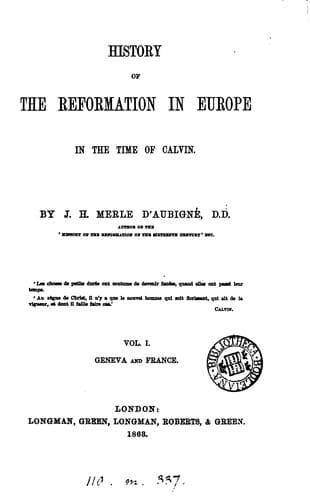
History of the Reformation in Europe in the Time of Calvin, Vol. 8 (of 8)Merle d'Aubigné, J. H. (Jean Henri)
History
History of the Reformation in Europe in the Time of Calvin, Vol. 8 (of 8)
Merle d'Aubigné, J. H. (Jean Henri)
Reformation
It might be asked how it came to pass that the queen did not put a
stop to these cruel executions. The answer is easy--she was herself
in danger. The enemies of the Reformation, perceiving her influence
over the king, bethought themselves that the execution of Anne Askew
and of her companions did not advance their cause; that to make it
triumphant the death of the queen was necessary; and that if Catherine
were ruined, the Reformation would fall with her. Shortly after the
king's return from France, these men approached him and cautiously
insinuated that the queen had made large use of her liberty during his
absence; that she diligently read and studied the Holy Scriptures;
that she chose to have about her only women who shared her opinions;
that she had engaged certain would-be wise and pious persons to assist
her in attaining a thorough knowledge of the sacred writings; that she
held private conferences with them on spiritual subjects all the year
round, and that 'in Lent every day in the afternoon, for the space of
an hour, one of her said chaplains, in her privy chamber,' expounded
the Word of God to the queen, to the ladies of her court and of her
bed-chamber and others who were disposed to hear these expositions;[448]
that the minister frequently attacked what he called the abuses of the
existing church; that the queen read heretical books proscribed by
royal ordinances; further, that she, the queen of England, employed her
leisure hours in translating religious works, and in composing books
of devotion; and that she had turned some of the psalms into verse,
and had made a collection entitled _Prayers or Meditations_. The king
had always ignored these meetings, determined not to see, what was
nevertheless clear, that the queen was an evangelical Christian like
Anne Askew, who had lately been burnt.
[Sidenote: ZEAL OF THE QUEEN.]
Catherine was encouraged by this consideration on the part of the king.
She professed her faith in the Gospel unreservedly, and boldly took up
the cause of the evangelicals. Her one desire was to make known the
truth to the king, and to bring him to the feet of Jesus Christ to find
forgiveness for the errors of his life. Without regard to consequences
she allowed her overflowing zeal to have free and unrestricted course.
She longed to transform not the king alone, but England also. She often
exhorted the king 'that as he had, to the glory of God and his eternal
fame, begun a good and a godly work in banishing that monstrous idol of
Rome, so he would thoroughly perfect and finish the same, cleansing and
purging his church of England clean from the dregs thereof, wherein as
yet remained great superstition.'[449]
Public-domain text, read in full here on John Shaqi.
Reviews
Reviews
No reviews yet
Be the first to share your thoughts on this work.
Elsewhere in the archive
Join the Discussion
Join the discussion
Sign in to leave a comment or review.
Sign InorCreate an account