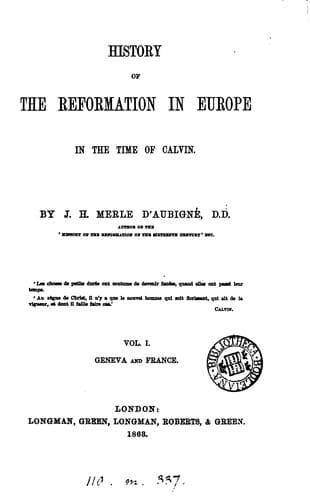
History of the Reformation in Europe in the Time of Calvin, Vol. 8 (of 8)Merle d'Aubigné, J. H. (Jean Henri)
History
History of the Reformation in Europe in the Time of Calvin, Vol. 8 (of 8)
Merle d'Aubigné, J. H. (Jean Henri)
Reformation
end of the conspiracy formed against the king's Protestant wife by
Wriothesley, Gardiner, and their friends. Henry then rejoined the
queen. His features still reflected his excitement and anger; but as
he approached her he tried to assume an air of serenity. She had not
clearly understood what was the subject of conversation between the
king and the chancellor; but the king's words had startled her. She
received him gracefully and sought to excuse Wriothesley, saying:
'Albeit I know not what just cause your majesty has at this time to
be offended with him, yet I think that ignorance, not will, was the
cause of his error; and so I beseech your majesty (if the cause be not
very heinous), at my humble suit to take it.' 'Ah, poor soul!' said
the king, 'thou little knowest how evil he deserveth this grace at thy
hands.'[463]
CHAPTER XI.
CLOSE OF THE REIGN OF HENRY VIII.
(1546-JANUARY, 1547.)
[Sidenote: THE NEW COURT.]
Weighty consequences followed the miscarriage of the conspiracy formed
against the queen. It had been aimed at the queen and the Reformation;
but it turned against Roman Catholicism and its leaders. The proverb
was again fulfilled,--'Whoso diggeth a pit shall fall therein.' The
wind changed; Romanism suffered an eclipse, it was no longer illumined
by the sun of royalty. The first to fall into disgrace with Henry VIII.
was, as we have seen, Wriothesley. The king displayed his coolness
in various ways. The chancellor, disquieted and alarmed for his own
pecuniary interests, was annoyed to see preparations for establishing
a new Court of Augmentations, by which his privileges and emoluments
would be lessened. He earnestly entreated the king that it might not be
established in his time. 'I shall have cause,' he wrote, on October 16,
'to be sorry in my heart during my life, if the favor of my gracious
master shall so fail, that partly in respect of his poor servant he do
not somewhat of his clemency temper it. Thus I make an end, praying God
long to preserve his Majesty.'[464] In spite of all his efforts, he
lost the royal favor, and the new court which he so much dreaded was
erected.
Public-domain text, read in full here on John Shaqi.
Reviews
Reviews
No reviews yet
Be the first to share your thoughts on this work.
Elsewhere in the archive
Join the Discussion
Join the discussion
Sign in to leave a comment or review.
Sign InorCreate an account