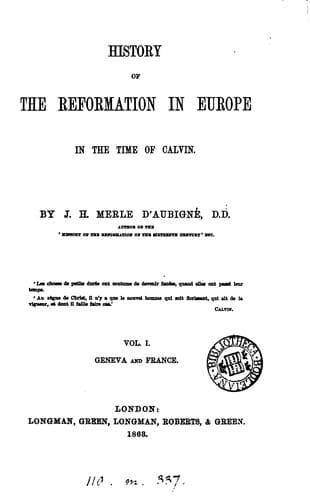
History of the Reformation in Europe in the Time of Calvin, Vol. 8 (of 8)Merle d'Aubigné, J. H. (Jean Henri)
History
History of the Reformation in Europe in the Time of Calvin, Vol. 8 (of 8)
Merle d'Aubigné, J. H. (Jean Henri)
Reformation
The new community was now organized; and Matthisson ere long
exercised over it supreme authority. Prophets who gave themselves
out for inspired did not wait for the millennial kingdom, or for the
resurrection of the dead, or for the advent of the Saviour. They were
quite equal, they thought, to their task. They despised knowledge.
They prohibited all intercourse with the _pagans_, that is to say, the
evangelicals. Those who received the new baptism indispensable for
admission into their imaginary kingdom, and they alone, were saints.
Marriages previously solemnized were annulled; laws were abolished
on the ground that they were opposed to liberty. All distinctions of
rank were suppressed; community of goods was established; and all the
property of those who were banished was thrown into a common fund.
At the same time, seeing that their first duty was to break with a
corrupt world, that irreconcilable enemy of the saints, orders were
given to destroy all those evil things of which the men of the world
made use. Images, organs, painted windows, clocks, seats adorned with
sculptures, musical instruments, and other things of a similar kind,
were removed into the market-place, and there solemnly broken to
pieces. The masterpieces of the painters of the Westphalian school were
not spared. Books and manuscripts, even the rarest, were some of them
burnt and others thrown upon dunghills.[516] This was all done, they
declared, by divine inspiration. People were at the same time ordered
to deliver up all gold, silver, jewels, ornaments, and other precious
things. Property was superseded by communism; and any one who failed
to bring these superfluities to the public office was put to death.
The leading fanatics divided among themselves the fine houses of the
canons, the patricians, and the senators, and settled in them in plenty
and comfort. A large number of adventurers in quest of fortune, and
of fanatics who coveted the good things of the world more than they
acknowledged, arrived at Munster from Holland and the neighboring
countries. They looked upon it as a fine opportunity, and were eager
to have a share of the spoil, and ready enough to lay hands on a large
portion of it. To each handicraft some special duty was assigned. The
tailors for example, were charged to see that no new form of dress was
introduced into the community. These people made it a matter of as much
moment to avoid the fashion as other people did to follow it.
Public-domain text, read in full here on John Shaqi.
Reviews
Reviews
No reviews yet
Be the first to share your thoughts on this work.
Elsewhere in the archive
Join the Discussion
Join the discussion
Sign in to leave a comment or review.
Sign InorCreate an account