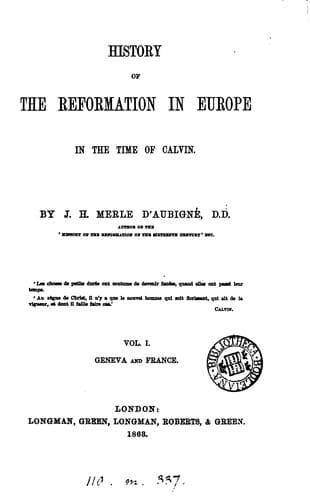
History of the Reformation in Europe in the Time of Calvin, Vol. 8 (of 8)Merle d'Aubigné, J. H. (Jean Henri)
History
History of the Reformation in Europe in the Time of Calvin, Vol. 8 (of 8)
Merle d'Aubigné, J. H. (Jean Henri)
Reformation
The prophets became more numerous. A working goldsmith, named
Tausendschur, pretended to great revelations. Urged on, no doubt,
by Bockhold, he called together the whole body of the saints, and
said,--'The will and the commandment of the Father who is in heaven is
that John of Leyden should have the empire of the whole world, that he
should go forth from the town with a powerful army, that he should put
to death indiscriminately all princes and kings, and that destroying
all the wicked he should take possession of the throne of David his
father.'[518] Bockhold, who was present, at first kept silent, and
appeared to know nothing of this revelation. But when Tausendschur
had finished, the Leyden tailor fell on his knees, and said that ten
days before the same things had been revealed to him, but that he had
refrained from announcing them, lest he should seem desirous of the
sovereignty. At length, he said, he submitted to the will of God,
applying to himself this saying of Ezekiel,--'David my servant shall
be their king, and he shall make an everlasting covenant with them.'
He therefore declared himself ready to undertake the conquest of
the world. This scheme was, doubtless, on his part, a mere piece of
trickery, but it abundantly served his ambition. The madmen and fools
who believed in it, voluntarily submitted to the man who was to be king
of the universe; and the hope of occupying the chief places in this
universal kingdom filled them with zeal for the support of Bockhold.
Even if there were any doubters, they knew that the impostor would not
hesitate to cut off their heads, if that should be necessary for the
establishment of his empire. Bockhold, whose mother was a serf of
Westphalia, assumed in the capital of this province the pomp and attire
of a king. He surrounded himself with a court composed of a large
number of officers and magistrates. The churches were pillaged; and
the king and his ministers decked themselves with the silk vestments
enriched with gold and silver which they took out of the churches, from
the officiating ministers and from the most wealthy citizens.[519] He
had a seal made, representing the world with two swords which pierced
it through and through. This he hung about his neck on a gold chain
adorned with precious stones, as a symbol of his power. He bore a
golden sword with a silver hilt; and on his head he had a triple crown
made of the finest gold. To all this ostentation the ex-journeyman,
now a king, added debauchery. Besides Divara, who was his queen, he
took fifteen wives, all under twenty years of age, and he declared that
he would have three hundred.[520] His queen and these young girls he
attired magnificently. Each of his apostles and other adherents also
had several wives. He considered it necessary to keep his followers in
a state of drunkenness, to prevent them from foreseeing the catastrophe
which was impending over them. He assumed the title of king of the
Public-domain text, read in full here on John Shaqi.
Reviews
Reviews
No reviews yet
Be the first to share your thoughts on this work.
Elsewhere in the archive
Join the Discussion
Join the discussion
Sign in to leave a comment or review.
Sign InorCreate an account