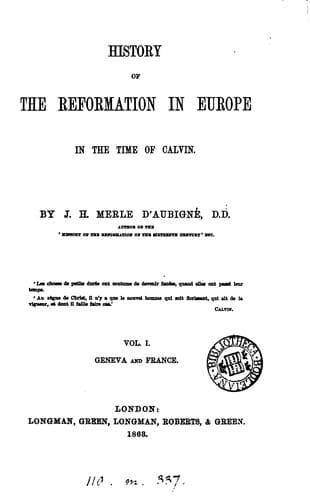
History of the Reformation in Europe in the Time of Calvin, Vol. 8 (of 8)Merle d'Aubigné, J. H. (Jean Henri)
History
History of the Reformation in Europe in the Time of Calvin, Vol. 8 (of 8)
Merle d'Aubigné, J. H. (Jean Henri)
Reformation
The king encountered difficulties not only in the neighboring towns,
but likewise in his own capital, and even in his harem. There was at
Munster a woman of great courage and determination, who boasted that
no man should ever marry her. John of Leyden commanded that she should
be carried off and placed in the number of his wives; but the woman,
with her independence of character, finding the morals and the manners
of this harem intolerable, made her escape. This was in the king's
eyes a very great crime. He therefore had her arrested, conducted her
himself to the great square, cut off her head with his own hand, and
then, filled with wrath and vengeance, trampled her body in the dust.
Bockhold had ordered that all his other wives should be present at this
hateful scene, and had directed them to sing a hymn of praise after the
execution. These unhappy creatures did, accordingly, strike up their
song in the presence of the mutilated and desecrated body of their
companion.[523]
CHAPTER V.
THE ANABAPTISTS OF MUNSTER. CHASTISEMENT.
(1535-1536.)
[Sidenote: CHASTISEMENT.]
The landgrave Philip of Hesse having, meanwhile, entered Westphalia
with the troops which had just made the conquest of Würtemberg, Munster
was soon so completely invested that nothing, and especially no food
supplies, could any longer enter the town. The dearth became more and
more severe, and the miserable people were driven to have recourse for
sustenance to the most unaccustomed food. They ate the flesh of horses,
dogs and cats, dormice, grass, and leather; they tore up books and
devoured the parchment. Half the population of the town, it was said,
died of starvation. These fanatics had trusted in the word of their
king and prophet, and had awaited with confidence the succor which he
promised them; but, as this succor did not arrive, murmurs began to be
heard from some of them, and others appeared to go mad. Bockhold had
told them that, if it were necessary for saving his people, 'the stones
would be turned into bread.' Consequently, some of these votaries might
be seen stopping in the streets, biting the stones and attempting to
tear them to pieces, in expectation of their being converted into
nourishment.[524] At length despair, madness, and inhumanity proceeded
to the bitterest extremities. The wife of the senator Menken, one of
the working men raised to this dignity by Bockhold, killed her three
children, salted their bodies, and placed the parts thus cured in jars,
in this way making abominable provision for her own subsistence, and
on this she fed day by day.[525] The wretched inhabitants of this
ill-fated town wandered with tottering steps about the streets, the
skin wrinkled over their fleshless bones, their necks long and lank,
hardly able to sustain the head, their eyes haggard and opening and
shutting with sudden jerk, their cheeks hollow and emaciated, with
Public-domain text, read in full here on John Shaqi.
Reviews
Reviews
No reviews yet
Be the first to share your thoughts on this work.
Elsewhere in the archive
Join the Discussion
Join the discussion
Sign in to leave a comment or review.
Sign InorCreate an account