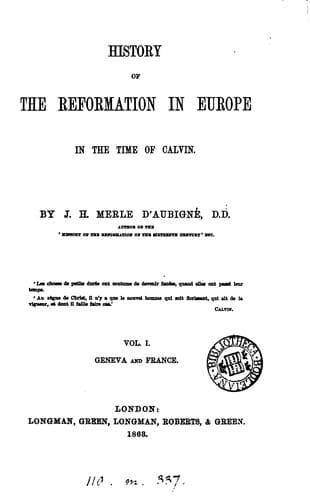
History of the Reformation in Europe in the Time of Calvin, Vol. 8 (of 8)Merle d'Aubigné, J. H. (Jean Henri)
History
History of the Reformation in Europe in the Time of Calvin, Vol. 8 (of 8)
Merle d'Aubigné, J. H. (Jean Henri)
Reformation
The queen of Hungary, governess of the Netherlands, who, from a strange
mixture of contradictory qualities, was desirous, while obliged to
execute the persecuting decrees of her brother against evangelical
Christianity, to feed upon the word of God, had chosen for her
chaplain one Peter Alexander, a true Christian man. This minister
faithfully confessed his trust in the Saviour, both in preaching and
in conversation. 'All things needful for salvation,' he said, 'are
contained in the Gospel. We must believe only that which is to be found
in the Holy Scriptures. Faith alone justifies immediately before God,
but works justify a man before his fellow-men. The true indulgences
are obtained without gold or silver, by trust alone in the merits of
Christ. The one real sin which condemns is not to believe in Christ.
The true penance consists in abstinence from sin. All the merits of
Christ are communicated to men by faith, so that they are able to glory
in them as much as if they were their own. We must honor the saints
only by imitating their virtues. We obtain a blessing of God more
easily by asking for it ourselves than through the saints.[155] No one
loves God so much as he ought. All the efforts and all the labors of
those who are not regenerated by the Holy Spirit are evil. The religion
of the monks is hypocrisy. The fast of God is a perpetual fast, and
not confined to this or that particular day. It is three hundred years
since the pure and real Gospel was preached; and now whoever preaches
it is considered a heretic.'
[Sidenote: THE QUEEN'S CHAPLAIN.]
It was a strange sight, this evangelical chaplain preaching in the
chapel of the most persecuting court in Christendom. Alexander, too,
after being frequently accused, was at length obliged to hold a
theological disputation with the confessor De Soto, in the presence of
the two Granvellas. In consequence of this disputation proceedings were
instituted against him. The confessor often came before the emperor
and declared that the whole country would be ruined if this man were
not severely punished. One day a friend of Enzinas came to see him in
prison, and told him that the queen's preacher had fled, because he
found that if he stayed an hour longer he would be ruined. Alexander
was tried and burnt in effigy, together with his Latin and French
books. As for himself, he became first a professor at the university
of Heidelberg, afterwards canon of Canterbury cathedral, and finally
pastor of the French church in London.
Public-domain text, read in full here on John Shaqi.
Reviews
Reviews
No reviews yet
Be the first to share your thoughts on this work.
Join the Discussion
Join the discussion
Sign in to leave a comment or review.
Sign InorCreate an account