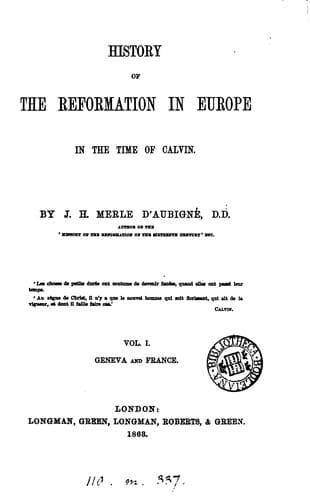
History of the Reformation in Europe in the Time of Calvin, Vol. 8 (of 8)Merle d'Aubigné, J. H. (Jean Henri)
History
History of the Reformation in Europe in the Time of Calvin, Vol. 8 (of 8)
Merle d'Aubigné, J. H. (Jean Henri)
Reformation
each according to the ability which he has received from the Lord, let
us cultivate our friendship by fulfilling all its obligations. My dear
Calvin, I have a most grateful sense of the affection which you profess
for me, and I will spare no pains to make myself worthy of it. You will
find in me a sincere friend.... With respect to the pamphlet which you
have addressed to the States of the Empire, Luther has read it and
praises it very heartily. Melanchthon very highly approves it. Cruciger
is wonderfully fond of you, and can not sufficiently commend any
production of yours. As to the censures of others you need not trouble
yourself about them.'[162]
Enzinas not only wrote to Melanchthon, but also went to him. He arrived
at Wittenberg in March, rather more than two years after leaving the
town. He related in detail to his master what had befallen him, and
what he had seen during these two years; and Melanchthon, struck with
his narrative, begged him to write and publish it. 'An account of the
cruelties practised towards Christian people in the Netherlands,' he
said, 'which you have seen with your own eyes, and which you have in
part experienced, for your life was in danger, might if published be
of great service for the future.'[163] Enzinas at first hesitated. 'At
the very time,' said he, 'when I was driven about by the fury of the
tempest, I endured patiently my personal sufferings, considering them
by far inferior to the perils of my brethren. How then can I, in this
hour when, thanks be to God, I am in port, set myself to recount my
own history, in seeming forgetfulness of the wounds of the church?' As
Melanchthon pressed the point, Francis declared that he would yield in
obedience to his command. The friend of Luther, thus satisfied, wrote
to Camerarius (April 16, 1545): 'Our Spaniard, Francis, has returned,
miraculously delivered, without any human aid, at least so far as he
knows. I have begged him to write an account of these things, and I
will send it to thee.' The interest which Melanchthon took in these
facts perhaps justifies the place which we have assigned them in the
history of the Reformation.
[Sidenote: JAMES ENZINAS AT ROME.]
Public-domain text, read in full here on John Shaqi.
Reviews
Reviews
No reviews yet
Be the first to share your thoughts on this work.
Join the Discussion
Join the discussion
Sign in to leave a comment or review.
Sign InorCreate an account