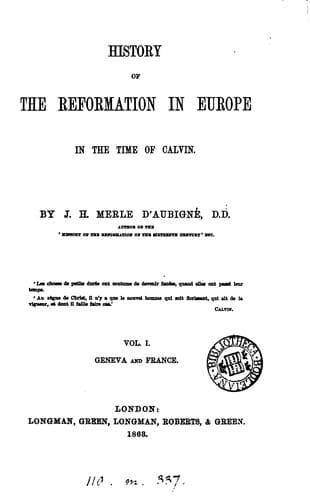
History of the Reformation in Europe in the Time of Calvin, Vol. 8 (of 8)Merle d'Aubigné, J. H. (Jean Henri)
History
History of the Reformation in Europe in the Time of Calvin, Vol. 8 (of 8)
Merle d'Aubigné, J. H. (Jean Henri)
Reformation
Along with this popular rumor another was current in Brussels, but in
higher circles. The emperor was at this time at Brussels, which town he
did not leave till April 30, 1545. Don Francis de Enzinas was not an
ordinary prisoner; not a working-man, a cutler, like Giles Tielmans.
An eminent family, a good education, learned attainments, talents, the
title of Spaniard, and of a Spaniard highly spoken of in high places,
these were things greatly esteemed by many at court. Charles the Fifth
himself was far from being unconscious of their importance. He had
promised his protection to Enzinas if there were nothing bad in his
book, and many persons assured him that there was, on the contrary,
nothing but good in it. How, then, could he put to death a scholar
for having translated into good Spanish the inspired book of the
Christians? According to public rumor the judges had said: 'We can not
honorably extricate ourselves from this cause; the best plan is to set
the man free secretly.' It was added that when the jailer had announced
the flight of Enzinas to the president, the latter had replied: 'Let
him go, and do not trouble about it; only do not let it be spoken of.'
If this version were the true one, it would explain the circumstance of
Zoëte's not appearing to recognize Enzinas. But Enzinas himself did not
credit it, and it is probable that it had no better foundation than the
first story.
[Sidenote: CALVIN AND ENZINAS.]
Francis remained a month at Antwerp. On his release from prison he had
sent the news to his friends, and had received their congratulations.
Among these friends were two of the most illustrious of the reformers,
Calvin and Melanchthon, between whom, whatever may be thought of
it, there were many points of resemblance. Calvin was the man, said
Enzinas, whom he had always most warmly loved.[159] He had written
a short letter to him, somewhat unpolished in style.[160] Calvin
replied to his friend immediately in a letter which breathed the most
affectionate feeling, and which Francis thought very remarkable. It
praised his labors and his Christian conduct. 'Oh,' said Enzinas, 'in
how kindly a manner he can speak of things which in themselves are not
deserving of praise!'[161] This singular kindliness of Calvin, which
then struck all his friends, has since been much called in question.
Enzinas replied to him (August 3): 'Our friendship,' said he, 'is now
sealed; between us there is a sacred and perpetual alliance, which can
only be broken by the death of one of us. What do I say? I have this
sweet hope, that when bodily ties shall be broken, we shall enjoy this
friendship in a future life with more exquisite delight than we can in
this mortal flesh. Not till then shall we live a life truly blessed,
and one which shall endure forever in the presence of God and in the
society of the holy angels. Nevertheless, while we are still in this
exile, and while we labor earnestly and unremittingly in our calling,
Public-domain text, read in full here on John Shaqi.
Reviews
Reviews
No reviews yet
Be the first to share your thoughts on this work.
Join the Discussion
Join the discussion
Sign in to leave a comment or review.
Sign InorCreate an account