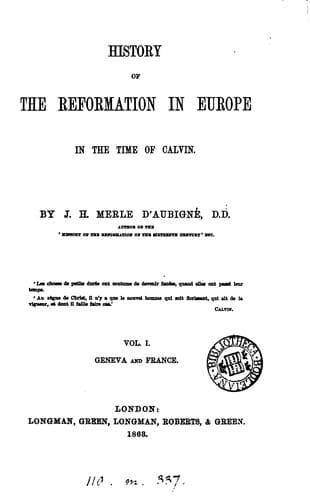
History of the Reformation in Europe in the Time of Calvin, Vol. 8 (of 8)Merle d'Aubigné, J. H. (Jean Henri)
History
History of the Reformation in Europe in the Time of Calvin, Vol. 8 (of 8)
Merle d'Aubigné, J. H. (Jean Henri)
Reformation
every part of Spain, to the end that the noblest minds, stimulated by
his example, may at length repent of the impiety in which at present
they are living.' This letter from Enzinas to Calvin was written from
Basel, April 14, 1547.
CHAPTER V.
FANATICISM AND BROTHERLY LOVE. JUAN DIAZ.
(1545-1547.)
[Sidenote: ENMITIES OF BROTHERS.]
History, both sacred and profane, opens, so to speak, with the
enmities of brothers. Cain and Abel, Atreus and Thyestes, Eteocles and
Polynices, Romulus and Remus, inaugurate with their murderous hatred
the origin of human society or the beginning of empires. This remark of
an eminent thinker, M. Saint-Marc Girardin, may be carried farther. In
the first days of Christianity, Jesus, when announcing to his disciples
the tribulations which awaited them, said: _The brother will deliver
up the brother to death_. Similar unnatural conduct is likewise to
be met with at the second great epoch of Christianity, that of the
Reformation. Strange! that a doctrine so worthy to be loved should be
enough to arouse hatred against those who profess it, and even hatred
of so monstrous a kind as to show itself in fratricide.
Brotherly love is one of the most beautiful features of human nature.
A brother is a friend, but a friend created with ourselves. Brothers
have the same father, the same mother, the same ancestors, the same
youth, the same family, and many things besides in common. A brother
is not merely a friend whom we meet and cling to, although that is no
small blessing; he is a friend given by God, a second self. But just
in proportion to the sacredness of the bond of brotherhood is the
depth of the evil when it is disregarded. The nearer brother stands
to brother, the deeper is the wound inflicted when they clash. The
noblest feelings of our nature are then trampled under foot, and
nothing is left but the most egotistic, the most savage instincts. The
man disappears, and the tiger takes his place. While the history of
the Reformation brings before us examples of the tenderest brotherly
affection, as, for example, in the case of the Enzinas, it presents us
also with some of those tragic catastrophes which must draw from us a
cry of horror.
[Sidenote: JUAN DIAZ.]
Public-domain text, read in full here on John Shaqi.
Reviews
Reviews
No reviews yet
Be the first to share your thoughts on this work.
Elsewhere in the archive
Join the Discussion
Join the discussion
Sign in to leave a comment or review.
Sign InorCreate an account