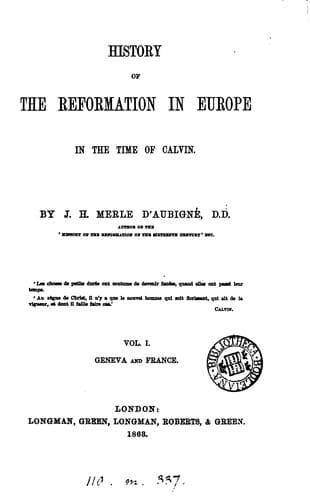
History of the Reformation in Europe in the Time of Calvin, Vol. 8 (of 8)Merle d'Aubigné, J. H. (Jean Henri)
History
History of the Reformation in Europe in the Time of Calvin, Vol. 8 (of 8)
Merle d'Aubigné, J. H. (Jean Henri)
Reformation
Among the Spaniards who were studying at Paris about 1540 there was,
besides James Enzinas, a young man from Cuença, named Juan Diaz. After
making a good beginning in Spain, he had gone in 1532 to complete his
studies at Paris, at the Sorbonne, at the Collège Royal, instituted by
Francis I. There, by his progress in learning, he had soon attained a
distinguished position among the students. At first he applied himself,
like a genuine Spaniard, to scholastic theology. He became intimate
with one of his fellow-countrymen, Peter Malvenda, a man older than
himself, and a doctor of the Sorbonne, who was subsequently much
employed by Granvella and by Charles the Fifth. Malvenda was a man
rich in resources, but also full of prejudices, superstitions, and the
pride which is the usual characteristic of the Roman doctors. Diaz, on
the contrary was characterized by great meekness, benevolence, candor
and simplicity, integrity, plain-dealing, prudence and purity of life.
Having a deep sense of the value of the sacred writings, he was anxious
to read them in the original, and therefore studied Hebrew and Greek
with unflagging earnestness. The reading of the sacred books opened
before him a new world. The conflict between two doctrines which was
agitating Christendom began within himself. What ought he to believe?
Diligent in prayer, says one of his biographers, he very fervently
prayed God to give him the pure knowledge of his holy will.[168] He
became intimate with his fellow-countryman, James Enzinas, and they
read the Scriptures together, James giving an explanation of them. The
eyes of Diaz were opened, and the same Spirit which had inspired the
sacred writers made known to him the Saviour whom they proclaimed. He
clung to him by faith and henceforth sought for righteousness in him
alone. He gave up the scholastic theology, embraced the Gospel, and
became the associate of men who shared his own convictions. Among these
were Claude de Senarclens, Matthew Budé, son of the illustrious William
Budé, and John Crespin, son of a jurisconsult of Arras, advocate to the
parliament of Paris. Impressed with the beauty of evangelical doctrine,
Diaz was convinced that he must not hide it. He burned 'to exhibit
it before the world,' he said. He felt at the same time the need of
gaining more knowledge and more power, and of being strengthened in
the faith by experienced teachers. He therefore left Paris and betook
himself to Geneva with Matthew Budé and Crespin, 'for the purpose of
seeing the state of the church in that town and the admirable order
which was established there.' Diaz stayed in the house of the minister
Nicholas des Gallars. This visit took place in 1545.[169]
Public-domain text, read in full here on John Shaqi.
Reviews
Reviews
No reviews yet
Be the first to share your thoughts on this work.
Elsewhere in the archive
Join the Discussion
Join the discussion
Sign in to leave a comment or review.
Sign InorCreate an account