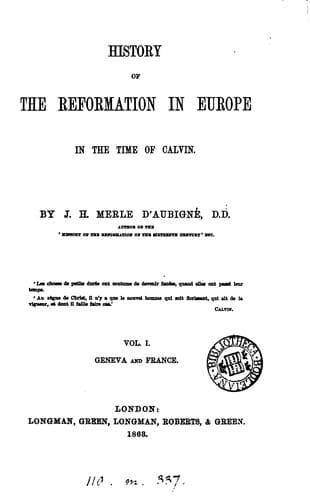
History of the Reformation in Europe in the Time of Calvin, Vol. 8 (of 8)Merle d'Aubigné, J. H. (Jean Henri)
History
History of the Reformation in Europe in the Time of Calvin, Vol. 8 (of 8)
Merle d'Aubigné, J. H. (Jean Henri)
Reformation
After having conversed with the great reformer, set forth his faith,
and received his approval of his doctrine as good and holy, Diaz
felt it desirable to visit the evangelical churches of Germany.
His stay extended to about three months, and he then went first to
Basel, afterwards to Strasburg. Bucer and his friends were delighted
with the young Spaniard, with his acquirements, his talents, his
agreeable manners, and especially with his piety. Admitted to
familiar intercourse with them, he entered more and more fully into
the knowledge of evangelical doctrines and affairs. He enjoyed the
conversation of these Christian people and the free and hearty manners
which prevailed among them. He had no thought of quitting Strasburg;
but a circumstance which occurred about six months afterwards led to
his removal.
[Sidenote: AT RATISBON.]
As the Protestants declined to recognize the Council of Trent, which
had been opened in December, 1545, the Elector Palatine had proposed
a colloquy between the two parties, and this conference opened at
Ratisbon, January 27, 1546. Bucer had been nominated one of the
delegates on the part of the Reformation; and the Senate of Strasburg,
judging that a Spanish convert from Catholicism to Protestantism, a
man rich in knowledge and in virtue, would carry much weight in the
discussion, associated Diaz with his friend. At Ratisbon, Bucer and
Diaz found as champions of the papacy, Malvenda, whom Diaz had known
at Paris, Cochlaeus,[170] and the Carmelite monk Billik. These three
were determined to maintain the extremest doctrines of the papacy; for
seeing that the council was assembled they feared that if they made
any concession they would be struck with the same anathemas as the
Protestants. Without hesitation Diaz went to see Malvenda. Malvenda was
his senior, and he ought to pay his respects to him. Perhaps he hoped
that the ties which had formerly united them would give him some hold
on the mind of his countryman. Presenting himself, therefore, with one
of his friends, he told him with the utmost simplicity that he was
come to Ratisbon with Bucer for the purpose of defending the doctrines
of the Reformation. Malvenda could believe neither his own eyes nor
ears. He remained for a short time astounded, as if some monster had
made its appearance.[171] The expression of his countenance and the
restlessness of his movements displayed his astonishment and alarm. At
length he said: 'What! Juan Diaz at Ratisbon! Juan Diaz in Germany, and
in the company of Protestants!... No, I am deceived; it is a phantom
before me, resembling Diaz indeed in stature and in feature, but it
is a mere empty image!' The young Spaniard assured the doctor that he
really was there present before him. 'Wretched man,' said Malvenda,
'do you not know that the Protestants will pride themselves far more
on having gained over to their doctrine one single Spaniard than if
they had converted ten thousand Germans or an in infinite number of
Public-domain text, read in full here on John Shaqi.
Reviews
Reviews
No reviews yet
Be the first to share your thoughts on this work.
Elsewhere in the archive
Join the Discussion
Join the discussion
Sign in to leave a comment or review.
Sign InorCreate an account