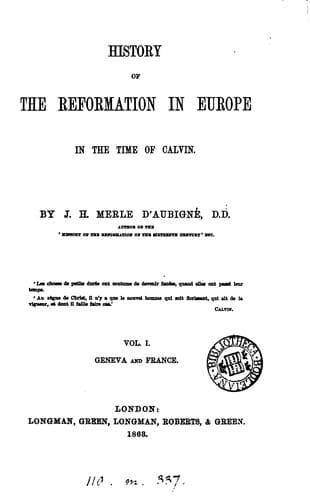
History of the Reformation in Europe in the Time of Calvin, Vol. 8 (of 8)Merle d'Aubigné, J. H. (Jean Henri)
History
History of the Reformation in Europe in the Time of Calvin, Vol. 8 (of 8)
Merle d'Aubigné, J. H. (Jean Henri)
Reformation
Juan, waking with a start, rose and went out of his chamber,
half-dressed, and received with kindliness his brother's messenger.
The latter handed a letter to him. The still faint light of the dawn
scarcely penetrated into the room; Juan went to the window and began
reading. Alonzo expressed to his brother the fears he felt for his
personal safety. 'Above all,' said he, 'do not trust Malvenda, who only
thirsts for the blood of the saints. From afar I watch over you, and in
giving you this warning I discharge a duty of brotherly piety.'[178]
While Diaz was reading, the murderer approached him, and, armed with
the hatchet which he had concealed under his cloak, plunged it up to
the handle in the skull of the unfortunate man, over the right temple.
So violent was the blow that the victim fell without uttering a word.
The assassin caught him in his arms and laid him quietly upon the
floor, and then fled without making any noise which might have betrayed
the horrible deed which had just been done.
The friend of Diaz, Senarclens, who was sleeping in his own chamber,
heard nothing but the footsteps of the murderer as he descended the
stairs. He rose hastily, ran to his friend, and found him dying. The
hatchet had been left buried in the wound. Juan Diaz lived an hour
longer but did not speak again. His hands were joined, his lips moved
as if in prayer, and his eyes fixed on heaven showed the mark toward
which he pressed.
Meanwhile the assassins were flying as fast as their horses could
carry them. Swiftly pursued, they passed through Augsburg without
stopping, and at length found refuge at Innspruch, in the dominions of
the archduke Ferdinand, king of the Romans. All Germany was stirred
by this odious crime; and the punishment of the guilty was demanded
from all quarters. But by the intervention of the emperor they escaped
the condemnation which they had deserved, and, if we are to believe
Castro,[179] Charles even raised the fratricide to the highest honors
and dignities.
CHAPTER VI.
SPANIARDS IN SPAIN.
(1534-1542.)
The doctrines of the Gospel were slowly spreading in Spain; their
advance was silent, but it was none the less rapid. The Catholic
Illescas, in his _Historia Pontifical_, asserts that 'so great were the
number, the rank, and the importance of the _culprits_, that if the
application of the remedy had been delayed for two or three months, the
whole of Spain would have been on fire.' The Reformation would have
wrought the salvation of this people, not only in a moral and religious
sense, but also in respect to national prosperity and greatness.
Unfortunately the papacy and Philip II. had the last word, and they
ensured its ruin.
[Sidenote: BARTHOLOMEW CARRANZA.]
Public-domain text, read in full here on John Shaqi.
Reviews
Reviews
No reviews yet
Be the first to share your thoughts on this work.
Elsewhere in the archive
Join the Discussion
Join the discussion
Sign in to leave a comment or review.
Sign InorCreate an account