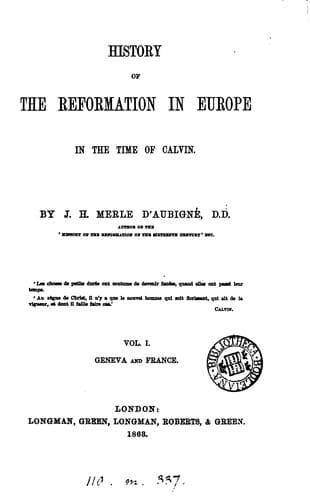
History of the Reformation in Europe in the Time of Calvin, Vol. 8 (of 8)Merle d'Aubigné, J. H. (Jean Henri)
History
History of the Reformation in Europe in the Time of Calvin, Vol. 8 (of 8)
Merle d'Aubigné, J. H. (Jean Henri)
Reformation
The marchioness of Alcagnices could not do without him. The piety
of Carranza met her deepest wants, and his attachment to Rome was a
ground of confidence to her that in adopting his faith she was not
separating from the church. Anxious to enjoy his teaching even when
he was absent, she caused copies to be made of his Spanish works,
and had translations made of those which were in Latin. In this task
she employed the friar Francis de Tordesillas. This monk, who was a
strictly orthodox man, was occasionally shocked, while making these
translations and copies, by certain phrases which appeared to have
a Lutheran tendency. He was very much grieved about it, and so much
the more because it was not only for the marchioness that he did this
work, but also for several other ladies, admirers of Carranza. What
a calamity if he should become an agent of the Lutheran heresy! And
yet there were so many fine things in those books, and Carranza was
so illustrious a doctor! The monk of Tordesillas bethought himself
of a means of preventing the evil. At the head of the manuscript he
put a _notice to the reader_, in which he said,--'that in reading the
works of Don Bartholomew, all the propositions which they contain must
be understood in the Catholic sense, and particularly those which
relate to justification, which it seems possible to interpret in an
opposite sense; that in this way there would be no danger of falling
into any error; that he had seen the author practice good works,
fasts, almsgiving and prayers, so that he, the speaker, was sure that
every thing which the doctor had written was in the spirit of the
Catholic religion.'[188] But the religious devotee labored in vain.
Most readers took simply and in the natural sense what they read.
Moreover the _notice to the reader_ was counteracted by more powerful
advice. Domingo de Roxas told both the nuns with whom he was connected,
particularly those of the convent of Bethlehem, and other persons who
showed any leaning to piety, that the evangelical doctrines, and he did
not scruple to say to many _the maxims of Luther_, were approved by a
man so virtuous and so learned as Carranza.[189]
Public-domain text, read in full here on John Shaqi.
Reviews
Reviews
No reviews yet
Be the first to share your thoughts on this work.
Elsewhere in the archive
Join the Discussion
Join the discussion
Sign in to leave a comment or review.
Sign InorCreate an account