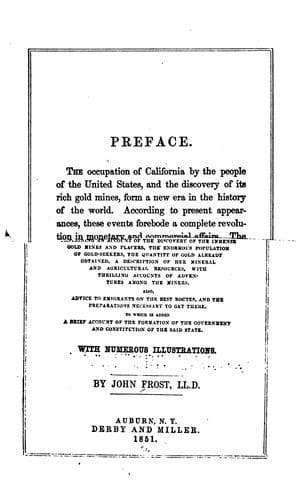
History of the State of California: From the Period of the Conquest by Spain to Her Occupation by the United States of AmericaFrost, John
History
History of the State of California: From the Period of the Conquest by Spain to Her Occupation by the United States of America
Frost, John
California -- Gold discoveries; California -- History
"If the movement shall continue five years, our commerce with that
territory may reach one hundred millions per annum. This is doubtless
a startling sum; but it must be borne in mind that we have to build
cities and towns, supply machinery for mining, coal for domestic
purposes, and steam navigation, and all the multifarious articles used
in providing the comforts and luxuries of life, for half a million of
people, who will have transferred themselves to a country which is to
produce, comparatively, nothing except minerals and the precious
metals, and whose pursuits will enable them to purchase, at any cost,
whatever may be necessary for their purposes.
"It is difficult to imagine or calculate the effect which will be
produced on all the industrial pursuits of the people of the Old
States of the Union, by this withdrawal from them of half a million of
producers, who, in their new homes and new pursuits, will _give
existence_ to a commerce almost equal in value to our foreign trade.
Let no one, therefore, suppose he is not interested in the welfare of
California. As well may he believe his interests would not be
influenced by closing our ports and cutting off intercourse with all
the world.
"The distance round Cape Horn is so great that bread-stuffs and many
other articles of food deteriorate, and many others are so perishable
in their nature that they would decay on the passage. This would be
the case particularly with all kinds of vegetables and undried fruits.
Until some more speedy mode of communication shall be established by
which produce can be transferred, the farmers and planters of the old
States will not realize the full value of this new market on the
Pacific.
"Many other important interests will be kept back, especially the
consumption of coal. The American steamers, now on that ocean, those
on their way there, and others shortly to be sent out, will consume
not far from one hundred thousand tons of coal per annum. The scarcity
of wood in California will bring coal into general use as fuel, as
soon as it can be obtained at reasonable prices. Suppose there may be,
three years hence, forty thousand houses, which shall consume five
tons each per annum. This, with the steamers, would be a consumption
of three hundred thousand tons. If delivered at $20 per ton, it would
compete successfully with the coal from Vancouver's Island and New
Holland, and amount to $6,000,000.
"The construction of a railroad across the Isthmus of Panama would
secure the market for those articles against all competition.
"Some idea may be formed of the demand for them from the prices paid
in San Francisco last autumn. Coal was sold at $60 to $100 per ton;
potatoes $16 per bushel; turnips and onions for 25 to 62½ cents each;
eggs from $10 to $12 per dozen.
Public-domain text, read in full here on John Shaqi.
Reviews
Reviews
No reviews yet
Be the first to share your thoughts on this work.
Elsewhere in the archive
Join the Discussion
Join the discussion
Sign in to leave a comment or review.
Sign InorCreate an account