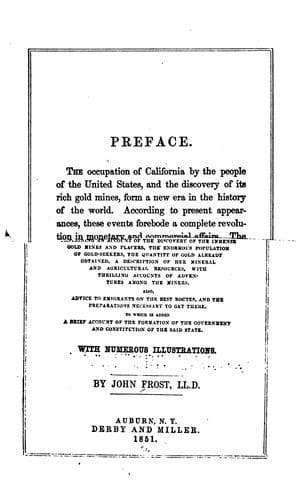
History of the State of California: From the Period of the Conquest by Spain to Her Occupation by the United States of AmericaFrost, John
History
History of the State of California: From the Period of the Conquest by Spain to Her Occupation by the United States of America
Frost, John
California -- Gold discoveries; California -- History
"This would give an aggregate of $20,000,000 for the first half of the
season--$15,000,000 of which was probably collected by foreigners.
During the last half of the season, the number of foreigners was very
much diminished, and, perhaps, did not exceed five thousand. At this
time, the American immigration had come in by land and sea, and the
number of our fellow-citizens in the mines had, as was estimated,
increased to between forty and fifty thousand. They were most of them
inexperienced in mining, and it is probable the results of their
labors were not so great as has been estimated for the first part of
the season, and experienced miners. Assuming that the average of half
an ounce per day ought to be considered as reasonable, it would give
an aggregate of about $20,000,000. If from this we deduct one-fourth
on account of the early commencement of the wet season, we have an
estimate of $15,000,000; at least five of which was collected by
foreigners, who possessed many advantages from their experience in
mining and knowledge of the country.
"These estimates give, as the result of the operations in the mines
for 1848 and 1849, the round sum of $40,000,000; one-half of which was
probably collected and carried out of the country by foreigners.
"From the best information I could obtain, I am led to believe that at
least $20,000,000 of the $40,000,000 were taken from the rivers, and
that their richness has not been sensibly diminished, except in a few
locations, which had early attracted large bodies of miners. This
amount has principally been taken from the northern rivers, or those
which empty into the Sacramento; the southern rivers, or those which
flow into the San Joaquin, having been, comparatively, but little
resorted to until near the close of the last season. These rivers are,
however, believed by those who have visited them, to be richer in the
precious metal than those in the northern part of the gold region."
Adopting the hypothesis that the gold found in these streams had been
cut or worn away from the veins in the quartz through which they have
forced their way, and considering the fact that they are all equally
productive, we may conjecture what a vast amount of treasure remains
undisturbed in the veins which run through the masses of rock over a
space of forty or fifty miles wide, and near five hundred miles long.
Such an estimate would almost defy our belief; yet, if the hypothesis
is true, there is no reason to doubt that the value of the gold which
that region will yield, is almost beyond calculation.
Public-domain text, read in full here on John Shaqi.
Reviews
Reviews
No reviews yet
Be the first to share your thoughts on this work.
Elsewhere in the archive
Join the Discussion
Join the discussion
Sign in to leave a comment or review.
Sign InorCreate an account