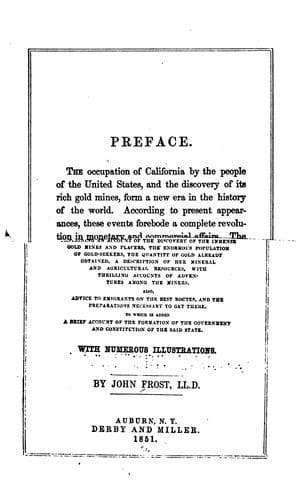
History of the State of California: From the Period of the Conquest by Spain to Her Occupation by the United States of AmericaFrost, John
History
History of the State of California: From the Period of the Conquest by Spain to Her Occupation by the United States of America
Frost, John
California -- Gold discoveries; California -- History
The crossing of the Kansas River is the next difficulty to be met.
There is a regular ferry about five miles from where the emigrants
cross the tributary creek. At that place the river is never more than
two hundred yards wide, even after heavy rains. The wagons are placed
in boats, owned by the Indians, and transported to the opposite shore
for the sum of one dollar per load. The oxen and horses are compelled
to swim across. Following the trail for about three miles, a place of
encampment, on the banks of Soldier Creek, is reached. The soil in the
neighborhood of the Kansas is luxuriantly productive, and the most
refreshing verdure meets the eye along the trails from that river to
Soldier Creek. The route is then pursued over a flat plain--boggy in
some places--for several miles, till another creek is reached, the
banks of which are steep, and this, as in other cases, make its
crossing a matter of great toil. The trail then runs over a high,
undulating country, presenting every variety of scenery, as far as
Black Paint Creek, near which are two Kansas Indian villages. The
Kansas are a friendly tribe, and if they were not, they are not
powerful enough to attack large parties of emigrants. They are
somewhat disposed to pilfer whatever they can conveniently, and
require close watching.
After crossing the creek, the trail is followed through a fertile
valley, across Hurricane Creek, which is somewhat difficult of
passage, and then over an open and rolling prairie, broken by small
branches and ravines. Many places, convenient for encamping, are to be
found on the route, some of which have springs of pure cold water.
Farther on, the ground becomes more broken, and Vermilion Creek, a
large and rapid stream, is reached. Its banks are steep, and its
fording very toilsome and difficult. Between this creek and the Big
Blue, there is neither wood nor water to be obtained, and therefore,
it is customary for the emigrants to fill their casks at this place.
The ground between the two streams, a distance of ten miles, is more
broken than any upon the former part of the route, and on arriving at
the Big Blue, a steep descent is made to the low, bottom lands near
the river. The usual width of the Big Blue is about a hundred yards,
at which time alone it is fordable. It becomes much swollen by heavy
rains, and very rapid in its current.
Public-domain text, read in full here on John Shaqi.
Reviews
Reviews
No reviews yet
Be the first to share your thoughts on this work.
Elsewhere in the archive
Join the Discussion
Join the discussion
Sign in to leave a comment or review.
Sign InorCreate an account