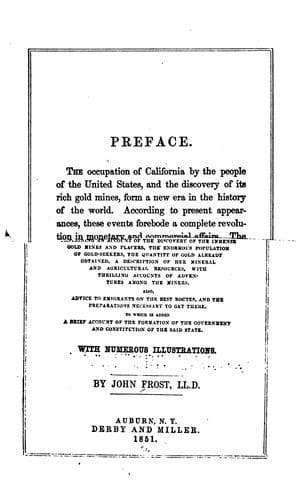
History of the State of California: From the Period of the Conquest by Spain to Her Occupation by the United States of AmericaFrost, John
History
History of the State of California: From the Period of the Conquest by Spain to Her Occupation by the United States of America
Frost, John
California -- Gold discoveries; California -- History
"The troops arrived in the vicinity of the lake, and came unexpectedly
upon a body of Indians numbering between two and three hundred. They
immediately surrounded them, and as the Indians raised a shout of
defiance and attempted escape, _poured in a destructive fire
indiscriminately upon men, women, and children_. 'They fell,' says our
informant, 'as grass before the sweep of the scythe.' Little or no
resistance was encountered, and the work of butchery was of short
duration. The shrieks of the slaughtered victims died away, the roar
of muskets then ceased, and stretched lifeless upon the sod of their
native valley were the bleeding bodies of these Indians--nor sex, nor
age was spared; it was the order of extermination fearfully obeyed.
The troops returned to the stations, and quiet is for the present
restored."
Here is the account of more Indian troubles.
"FIGHT WITH THE SACRAMENTO INDIANS.--TREATY.--In consequence of
depredations of the Indians of the Sacramento valley and outrages
committed by them, General Thomas J. Green, 1st Division, State
Militia, ordered out two companies of Mounted Volunteers, under
command of Captain Allgiers and Captain Charles Hoyt, and marched from
Oro, on the 17th of May, in the direction of Deer Creek. On the same
day Lieutenant Bell, of Captain A.'s company, with ten men,
encountered a large number of Indians, killed five, and took six
prisoners.
"On the 18th the command scoured the country in the region of Deer
Creek and Bear River. On the 19th, the trail to Colonel Holt's mill,
where he was murdered, was taken, the villages found to be deserted,
and the white settlement abandoned.
"On the 20th, the Indians, two or three hundred strong, were
discovered within two miles of Bear River, upon an elevated conical
hill. An engagement took place, in which eleven Indians were killed
and a number wounded. About fifty of the state volunteers were
engaged. None were killed, but Captain Hoyt, Lieutenant Lewis, and Mr.
Russell were wounded. Major Frederick Emory (brother of Major Emory,
United States Topographical Engineers of the boundary Commission,) was
accidentally shot through the thigh with a rifle ball. He was
aid-de-camp to General T. J. Green.
"On the 25th, the Indian Chiefs Weimer, Buckler, and Pooliel, came in,
by permission, and entered into a treaty of peace between the three
tribes, severally represented, and the State of California and
Government of the United States. The treaty is sensible and
comprehensive."
Public-domain text, read in full here on John Shaqi.
Reviews
Reviews
No reviews yet
Be the first to share your thoughts on this work.
Elsewhere in the archive
Join the Discussion
Join the discussion
Sign in to leave a comment or review.
Sign InorCreate an account