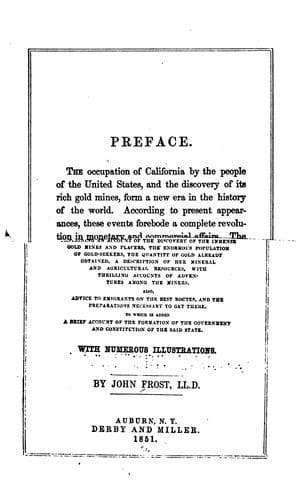
History of the State of California: From the Period of the Conquest by Spain to Her Occupation by the United States of AmericaFrost, John
History
History of the State of California: From the Period of the Conquest by Spain to Her Occupation by the United States of America
Frost, John
California -- Gold discoveries; California -- History
There is a prospect that the seat of government of California will be
removed from San José to the proposed new city of Vallejo, about
twenty miles above San Francisco, near the Straits of Carquinez, and
at the junction of the Napa and San Pablo Bays. The new city has
already been surveyed, and a company of influential capitalists
organized, with the determination to "go ahead," whether the capital
is or is not established at this point. The site no doubt presents
many advantages for a large commercial city, not possessed by San
Francisco. The distance from the "Golden Gates," (as the entrance
from the Pacific to the succession of bays connected with the harbor
of San Francisco is termed) is about the same as San Francisco. The
harbor is one of the safest and most commodious in the world, and the
commissioners appointed by the general government to make surveys and
decide upon the best location, have to recommend Mare's Island, half a
mile from Vallejo, as the naval depot of the United States in
California. The climate of Vallejo is delightful, and the place is
never subjected to those strong and cold northerly winds which render
San Francisco so disagreeable as a residence and so dangerous as a
commercial city. There is plenty of marble for building purposes in
the immediate vicinity of Vallejo, and plenty of limestone at a
convenient distance, and easily obtainable. The new city will command
a most beautiful view of San Pablo Bay and of the country adjacent,
and the Napa valley (through which the Napa River flows, and near the
mouth of which the city is located,) and the Sonoma valley in the
vicinity are among the most fertile in California. Near Vallejo are
also mineral springs, possessing similar properties, and said to equal
the celebrated Congress Springs at Saratoga.
CHAPTER XIII.
THE MINERALOGICAL AND OTHER CHARACTERISTICS OF GOLD, AND THE
MODE OF DISTINGUISHING IT WHEN FOUND; TOGETHER WITH THE
ASSAY, REDUCTION, AND REFINEMENT OF GOLD.
For the purpose of presenting all that is connected with that precious
metal, that has built up a state within a few years, and of making the
reader fully acquainted with all that is necessary for the gold-seeker
to know, we will now describe, in some detail, the natural history,
character of gold, and the mode of determining its presence and value.
Gold _invariably_ exhibits something of the peculiar yellow color
which it is known to possess in a pure state; but this color is
modified by various metals with which it may be mixed. Thus it may be
described as having various shades of gold-yellow; occasionally
approaching silver-white, occasionally resembling brass-yellow of
every degree of intensity, and even verging on steel-gray in some
specimens from South America.
Public-domain text, read in full here on John Shaqi.
Reviews
Reviews
No reviews yet
Be the first to share your thoughts on this work.
Elsewhere in the archive
Join the Discussion
Join the discussion
Sign in to leave a comment or review.
Sign InorCreate an account