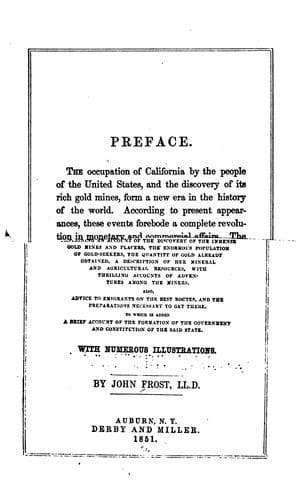
History of the State of California: From the Period of the Conquest by Spain to Her Occupation by the United States of AmericaFrost, John
History
History of the State of California: From the Period of the Conquest by Spain to Her Occupation by the United States of America
Frost, John
California -- Gold discoveries; California -- History
We have followed the narrative of the events in the history of
California up to the present time. We have traced her progress from
her first settlement up to the time when she appears as a sovereign
republican State; and we have seen the effects of her vast metallic
wealth working wonders in a short space of time. We have seen her
towns before and after the gold discovery, and marked the contrast;
and we have seen her territory become thickly peopled, and her
resources developed in a space of time which other territories less
favored, would require for an infancy. We have also considered her
soil, climate, productions, and population, and exhibited each subject
as fully as our information warranted. But in order to give a clear
conception of the general character of California and her resources
and capabilities, and to enable the reader to obtain an idea of the
bright future to which she is destined, we have concluded to add
another chapter upon the general state of things there at the present
time.
California is now a State--in organization at least, if not in being a
member of the Union. The country has become thoroughly American in its
government and laws. A Constitution is adopted as a State organization,
which bears the impress of enlightened sentiment and just principles.
The most liberal provisions have been made in that instrument for the
grand end of public education. The power and capability of the people
to rule themselves has been recognized in the matter of electing
nearly all the officers of the government--including the judges of the
various courts over which the State has control. The Legislature, in
the course of a laborious session, has abolished the old civil law
which ruled the country under the Mexican government, and continued
after the acquisition of the territory by the United States, and have
substituted the common law of England and many of the States in the
Union. In taking this step, they were actuated by sound policy. Few of
those who were subjected to be tried, or to have their suits decided
by the rules of this civil code were aware of the nature of these
rules; and from their crude and unintelligible character, it would
have been a long time before they could have been fully or certainly
informed. The old common law is that to whose rules they have
conformed in the older States, and which is better suited to their
habits and principles of action.
But with her complete State organization, California has applied for
admission into the Union, and from various causes, without reason, as
we conceive, has not yet been admitted to her claim. This delay,
continued through a long session of Congress, has somewhat irritated
the Californians, who are anxiously watching the doings of Congress.
The state of feeling on the subject is clearly stated in one of the
California papers; and it is worthy of attention. We extract it.
Public-domain text, read in full here on John Shaqi.
Reviews
Reviews
No reviews yet
Be the first to share your thoughts on this work.
Elsewhere in the archive
Join the Discussion
Join the discussion
Sign in to leave a comment or review.
Sign InorCreate an account