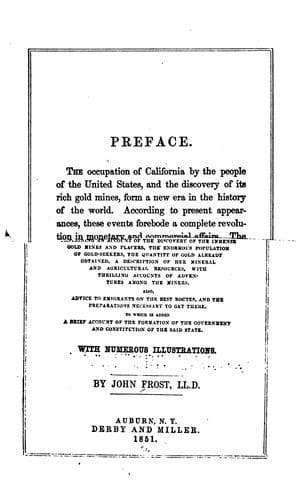
History of the State of California: From the Period of the Conquest by Spain to Her Occupation by the United States of AmericaFrost, John
History
History of the State of California: From the Period of the Conquest by Spain to Her Occupation by the United States of America
Frost, John
California -- Gold discoveries; California -- History
In establishing a boundary for the State, the convention conformed, as
near as was deemed practicable and expedient, to great natural
landmarks, so as to bring into a union all those who should be
included by mutual interest, mutual wants, and mutual dependence. No
portion of territory is included, the inhabitants of which were not or
might not have been legitimately represented in the convention, under
the authority by which it was convened; and in unanimously resolving
to exclude slavery from the State of California, the great principle
has been maintained, that to the people of each State and Territory,
alone, belongs the right to establish such municipal regulations, and
to decide such questions as affect their own peace, prosperity and
happiness.
A free people, in the enjoyment of an elective government, capable of
securing their civil, religious, and political rights, may rest
assured these inestimable privileges can never be wrested from them,
so long as they keep a watchful eye on the operations of their
government, and hold to strict accountability those to whom power is
delegated. No people were ever yet enslaved, who knew and dared
maintain the co-relative rights and obligations of free and
independent citizens. A knowledge of the laws--their moral force and
efficacy, thus becomes an essential element of freedom and makes
public education of primary importance. In this view, the Constitution
of California provides for, and guarantees in the most ample manner,
the establishment of common schools, seminaries and colleges, so as to
extend the blessings of education throughout the land, and secure its
advantages to the present and future generations. Under the peculiar
circumstances in which California becomes a State--with an unexampled
increase of a population coming from every part of the world, speaking
various languages, and imbued with different feelings and prejudices,
no form of government, no system of laws, can be expected to meet with
immediate and unanimous assent. It is to be remembered, moreover, that
a considerable portion of our fellow-citizens are natives of Old
Spain, Californians, and those who have voluntarily relinquished the
rights of Mexicans to enjoy those of American citizens. Long
accustomed to a different form of government, regarding the rights of
person and of property as interwoven with ancient usages and
time-honored customs, they may not at once see the advantages of the
proposed new government, or yield an immediate approval of new laws,
however salutary their provisions, or conducive to the general
welfare. But it is confidently believed, when the government as now
proposed shall have gone into successful operation, when each
department thereof shall move on harmoniously in its appropriate and
respective sphere, when laws, based on the eternal principles of
equity and justice, shall be established, when every citizen of
California, shall find himself secure in life, liberty, and
Public-domain text, read in full here on John Shaqi.
Reviews
Reviews
No reviews yet
Be the first to share your thoughts on this work.
Elsewhere in the archive
Join the Discussion
Join the discussion
Sign in to leave a comment or review.
Sign InorCreate an account