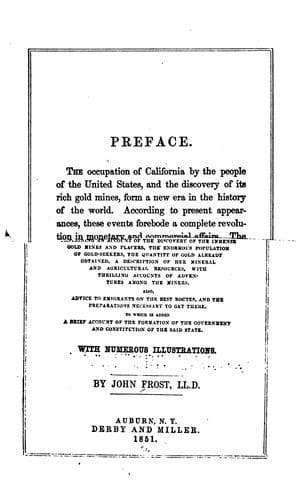
History of the State of California: From the Period of the Conquest by Spain to Her Occupation by the United States of AmericaFrost, John
History
History of the State of California: From the Period of the Conquest by Spain to Her Occupation by the United States of America
Frost, John
California -- Gold discoveries; California -- History
They are situated within a circuit of some twelve or fifteen miles,
and are known as Jamestown, Wood's Creek, Sonoranian Camp, Sullivan's
Creek, Curtis's Creek, French Creek, Carson's Creek, and Angelo Creek.
Some of these have become places of considerable business,
particularly the Sonoranian Camp, which presents the appearance of a
city of canvas houses.
Passing the Stanislaus River in the mountains, we proceeded to Major
Kingsbury's camp near the mouth of the American River, crossing in our
route the Calaveras, Moquelume, Seco, and Cosumnes Rivers; all of
which have rich washings near their sources, and on their bars and
islands. From Major Kingsbury's camp we ascended the American River to
Cullamo Hills, where the first placer was discovered by Captain
Sutter's employees in the spring of 1848. From Cullamo we crossed the
country to Stockton, a new town on an estero some distance above the
mouth of the San Joaquin, and thence proceeded to Colonel Cazey's camp
at the straits of Carquinnes; returning via San Francisco to Monterey,
which place we reached on the afternoon of the 9th instant.
We found the country at this season dry and parched by the sun, the
heat of which became very great the moment we crossed the coast range
of mountains. The thermometer ranges as high as 113° Fah. in the
shade, and above 140° Fah. in the sun. A great portion of the valley
of the Joaquin is so barren as scarcely to afford subsistence for our
animals, and can never be of much value for agricultural purposes.
There, however, is, some excellent land on the east side of that
river, bordering its large tributaries. A considerable portion of the
valleys of the Moquelume, Seco, Cosumnes, and American Rivers is also
well adapted to agriculture; and the broad plains lying between them
furnish abundant pasture for raising stock. But the amount of good
arable land, as compared with the extent of country which we passed
over, is small, and I am inclined to believe that the richness and
extreme fertility of certain localities have led to erroneous
conclusions respecting the general character of the country. Certain
it is, that while there may be found sufficient arable lands to
support, if well cultivated, a numerous population, here is also a
very great extent of rough and mountainous country and sandy and
barren plains which are of little value. The great difficulty to be
encountered in agricultural pursuits in some portions of California is
the want of water for irrigation; but possibly this difficulty may be
overcome in part by resorting to artesian wells. If so, much of the
public land which is now unsaleable may be brought into market, and
the settlement of the country greatly accelerated. I would, therefore,
suggest whether it may not be advisable for our government to direct
some experiments to be made at the public expense in sinking wells of
this character, for even if unsuccessful as a means of irrigation,
Public-domain text, read in full here on John Shaqi.
Reviews
Reviews
No reviews yet
Be the first to share your thoughts on this work.
Elsewhere in the archive
Join the Discussion
Join the discussion
Sign in to leave a comment or review.
Sign InorCreate an account