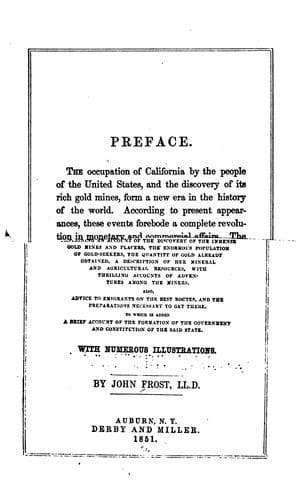
History of the State of California: From the Period of the Conquest by Spain to Her Occupation by the United States of AmericaFrost, John
History
History of the State of California: From the Period of the Conquest by Spain to Her Occupation by the United States of America
Frost, John
California -- Gold discoveries; California -- History
and military marine in case of war with any naval power, will, it is
believed, fully justify the expenditures necessary for securing this
port against a maritime attack.
III. _Commercial and military importance of Lower California._--Thus
far in my report I have proceeded on the supposition that it is the
intention of our government to retain the whole of California in any
treaty of peace with Mexico; but doubts have recently been expressed
on the policy of retaining this peninsula, on account of its being of
little or no value to the United States. As the guerrilla forces which
were sent over from Mexico the past summer, during the absence of our
squadron from this coast, to regain possession of Lower California,
and force the inhabitants to their allegiance to the Mexican
government, have been defeated and completely dispersed, leaving our
own troops in undisputed possession of the territory, nothing but a
conviction of the utter worthlessness of the country could now induce
our government to consent to its abandonment. On this subject I beg
leave to add a few remarks:
The peninsula of California lies between twenty-two degrees fifty
minutes and thirty-two degrees thirty minutes north latitude, being
about seven hundred miles in length, and varying from fifty to one
hundred miles in breadth. An irregular chain or broken ridge of
mountains extend from Cape St. Lucas to the frontiers of Upper
California, with spurs running off on each side to the gulf and ocean.
Between these spurs are numerous broad plains covered with stunted
trees, and during the rainy months with a thin but nutricious grass.
In the dry season this grass is parched up like hay, but from its
nutricious character it affords abundant food for the herds of cattle
and horses which constitute the principal wealth of rancheros. The
dryness of the soil prevent the growth of trees of any considerable
magnitude, except on the borders of a few mountain streams. This
timber, though far from being plentiful, is exceedingly durable and
much esteemed in ship-building. The greatest height of the mountains
is estimated five thousand feet; many of them are piles of mere
broken rocks, while others are covered with grass, shrubbery, and
small trees. The plains are sandy and mostly unproductive--not,
however, from any natural barrenness in the soil, but from a
deficiency of water. There are but few durable streams in the whole
country, and streams of good water are extremely scarce. But in the
plains and most of the dry beds of rivers water can be obtained by
digging wells only a few feet in depth; and wherever irrigation has
been resorted to by means of these wells, the produce of the soil,
from its remarkable fertility, has abundantly rewarded the labor of
the agriculturist. Much of this soil is of volcanic origin, having
been washed from the mountains by the action of heavy rains, and the
produce extracted by means of irrigation from these apparently barren
Public-domain text, read in full here on John Shaqi.
Reviews
Reviews
No reviews yet
Be the first to share your thoughts on this work.
Elsewhere in the archive
Join the Discussion
Join the discussion
Sign in to leave a comment or review.
Sign InorCreate an account