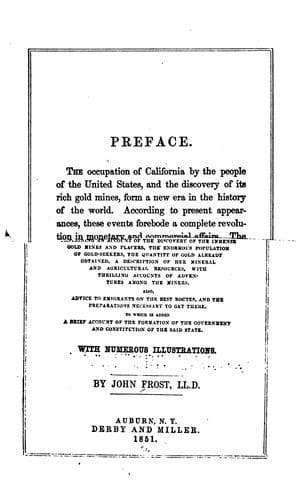
History of the State of California: From the Period of the Conquest by Spain to Her Occupation by the United States of AmericaFrost, John
History
History of the State of California: From the Period of the Conquest by Spain to Her Occupation by the United States of America
Frost, John
California -- Gold discoveries; California -- History
Where the city of Sacramento now stands, at the time of the gold
discovery, there stood, "solitary and alone," a small fort. This
formed the nucleus, about which, at the commencement of the rush of
emigration, the town soon sprang into existence. Its increase has been
almost as rapid as that of San Francisco. During the rainy season of
the early part of 1850, the population numbered somewhere between
twenty and thirty thousand. But at that period, a considerable portion
of the gold-diggers made Sacramento and the other towns in the
neighborhood of the mines, their resort, to escape the severity of
spending the season at the open and exposed valleys of the gold
region. The city is regularly laid out, but its appearance evidences
the rapidity of its erection. The greater number of the houses and
stores in the neighborhood of the river are constructed of wood, while
the outskirts, particularly upon the south, are occupied by the tents
of the constantly-arriving overland emigrants. Before the commencement
of the last rainy season, the number of these emigrants reached two or
three thousand. They squatted upon the vacant lots which had been
surveyed and sold to other persons. This caused a considerable
agitation in the town, which continued till the disastrous flood swept
both the parties off the ground, and thus left the field clear for
another commencement. Sacramento is the grand receptacle of the
overland emigration, and this, combined with its commercial
facilities, will continue to give the city a superiority over the
majority of the other places in California.
Adjoining Sacramento city, is the town of Sutter. It is situated on
the highest and healthiest ground on the river. It is not, like
Sacramento, subject to an annual overflow. The town was originally
laid out by Captain Sutter and others; and is owned by Hon. John
McDougall, Lieutenant-Governor of California, and Captain Sutter. It
has a thriving business population, and its position, and the
fertility of the neighboring country will soon make it a place of
importance.
Stockton is to the southern portion of the gold region what Sacramento
is to the northern. It is situated upon a slough, or a succession of
sloughs, containing the back waters formed by the junction of the San
Joaquin and Sacramento Rivers. It is about fifty miles from the mouth
of the San Joaquin, and one hundred from San Francisco. The ground
upon which it is situated is high and is not subject to overflow.
Vessels drawing nine feet water can ascend the San Joaquin as far as
Stockton, and discharge their cargoes on the bank. In the latter part
of 1848, the town was laid out and a frame building erected by Charles
M. Weber. In eight months from that time, it contained a population of
about two thousand permanent residents, and a large number of
temporary residents, on their road to the mines. Communication is with
San Francisco by means of steamboats and launches, and the commerce of
the town is constantly increasing.
Public-domain text, read in full here on John Shaqi.
Reviews
Reviews
No reviews yet
Be the first to share your thoughts on this work.
Join the Discussion
Join the discussion
Sign in to leave a comment or review.
Sign InorCreate an account