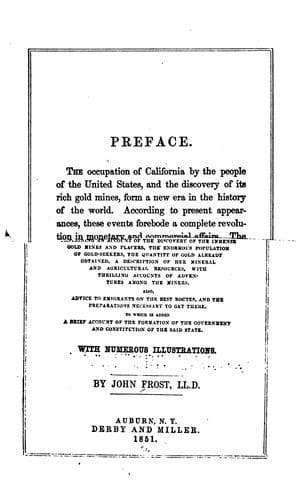
History of the State of California: From the Period of the Conquest by Spain to Her Occupation by the United States of AmericaFrost, John
History
History of the State of California: From the Period of the Conquest by Spain to Her Occupation by the United States of America
Frost, John
California -- Gold discoveries; California -- History
The principal port of Lower California is La Paz, situated near the
mouth of the gulf. The bay on the shore of which the town is located,
is of great extent and beauty, and possesses a large number of rich
pearl oyster-beds--the pearl fishery having at one time supplied the
chief article of traffic on this part of the coast. The country around
the bay is elevated and picturesque, though rugged; the soil being
composed principally of rock and sand, wildly and irregularly covered
with the most prickly species of stunted bushes and shrubs of sunburnt
hue. The town of La Paz is neatly built and presents a pretty
appearance. The streets are lined with willow trees, and these meeting
overhead, form a delicious shade during the heat of the day. The
houses are all constructed of _adobés_, plastered white, and thatched
with the leaves of the palm tree. The beach is lined with palms,
cocoa-nut, fig and tamarind trees. La Paz was taken by the American
volunteers during the war with Mexico, and considerable destruction of
the orchards, gardens and houses of the town was the consequence. The
harbor offers great advantages for a naval station, and such,
doubtless, it will become.
San José, the most southern town of Lower California, is situated
about half-way between Cape San Lucas and Cape Palmo, on a sort of
desert plain, extending from the beautiful valley of San José to the
ocean. It is located about three miles from the beach, and is one of
the strangest creations in the shape of a town imaginable.
The heavy rains and freshets which occur in the wet season, in this
region, render every elevation invaluable as a preservative against
the dangers of sudden inundations; hence all the houses are built
upon steeps, rocks, and hillocks, necessarily irrespective of order;
so that, even in the most densely populated districts, barren hills,
as yet unoccupied by dwellings, are frequently to be met with, with
deep hollows in every part, converting mere visits into positive
enterprises, in most instances both tedious and disagreeable. To these
great natural disadvantages, the indolence of the inhabitants has
added others, their common practice being to dig for _adobé_ clay at
the nearest convenient spot, namely, for the most part, opposite their
own doors; thus, one would imagine that the site of the whole town had
been visited and disturbed by a succession of miniature earthquakes,
which, whilst they had left the houses themselves unshaken, had heaved
and perched them up in the most uncomfortable positions, and in the
most inaccessible places. In the very centre of the principal street,
which appears to have once upon a time been level, are three or four
immense clay-pits, serving as a receptacle for dead dogs, cats, bones,
vegetable refuse, and, in a word, every description of rubbish and
nuisance a very dirty population can convey to or discharge in them.
Public-domain text, read in full here on John Shaqi.
Reviews
Reviews
No reviews yet
Be the first to share your thoughts on this work.
Join the Discussion
Join the discussion
Sign in to leave a comment or review.
Sign InorCreate an account