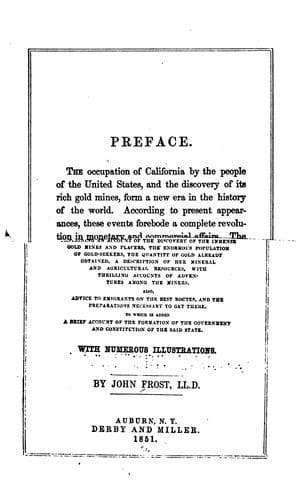
History of the State of California: From the Period of the Conquest by Spain to Her Occupation by the United States of AmericaFrost, John
History
History of the State of California: From the Period of the Conquest by Spain to Her Occupation by the United States of America
Frost, John
California -- Gold discoveries; California -- History
But a description of the town would be incomplete without adding that
it is dotted about in these hollows, and in the sand-holes in the
rocks, with patches of thorn, brush, and cacti, forming a singular yet
refreshing contrast with the general barrenness of the region itself,
the whole being surrounded by a bleak mountainous range, which
increases in elevation until it blends with the clear sky, far in the
distance.
The principal, indeed the only regular street in the town, is wide and
long, the houses being constructed of _adobés_ and cane, thatched with
palm leaves. It is blocked up at the remoter end by the fort, which
stands upon a wide foundation of rock of considerable elevation;
various portions of the _adobé_ walls connecting the crags having been
pierced, so as to allow artillery to be trained through the
embrasures, whilst, in other parts, there are numerous loop-holes for
musketry. There are some very awkward cavities amongst these rocks,
produced by digging for clay for the _adobé_ work. The fort is
flat-roofed and parapetted, having portholes for cannon; and below, in
the very centre of the building, occupying about a third of its entire
length, runs a thick wall, forming a crescent, well mounted with heavy
guns. At the end of this crescent, between it and the front wall, is
the entrance to the fort--a mere aperture, barely wide enough to allow
of one man's passing in.
These defences proved to be of great advantage to a small party of
Americans that landed at San José, during the war between the United
States and Mexico, and were compelled to take shelter in the old
quartel, or barracks. There they were surrounded by the Californians,
and stood a siege of several weeks', suffering incredible hardships.
The population of San José numbers about three thousand, the majority
being semi-Indians, or the pure descendants of the Mexicans. There is
little promise of any considerable increase in the size of the town,
owing to the natural disadvantages of situation.
Public-domain text, read in full here on John Shaqi.
Reviews
Reviews
No reviews yet
Be the first to share your thoughts on this work.
Join the Discussion
Join the discussion
Sign in to leave a comment or review.
Sign InorCreate an account