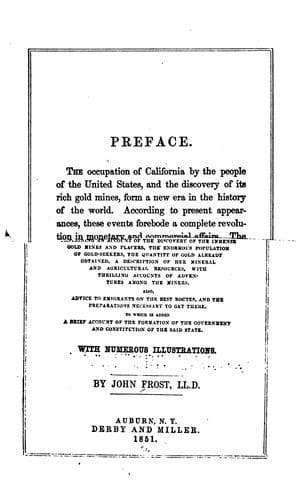
History of the State of California: From the Period of the Conquest by Spain to Her Occupation by the United States of AmericaFrost, John
History
History of the State of California: From the Period of the Conquest by Spain to Her Occupation by the United States of America
Frost, John
California -- Gold discoveries; California -- History
The other towns of Lower California are--San Antonio, in the
neighborhood of an extensive silver mine, which has been worked for a
long time with considerable profit; Loreto, on the gulf coast, about
two hundred miles north of La Paz; San Domingo and Todos Santos, on
the Pacific coast. The latter town is situated on the bay of the same
name, and is the most northerly part of Lower California. The church
and mission buildings at this place are the largest and most imposing
structures of the kind in Lower California. The church has a handsome
front and a lofty steeple. The mission is the residence of the head of
the church in Lower California. There is every reason to believe,
that, when the richer portions of Upper California begin to get a
little crowded, the tide of emigration will be turned to the south,
and the ports of the peninsula will become of great commercial
importance. Then, if not before, the country will become the property
of the United States, either by way of purchase, or after the manner
of Texas.
CHAPTER IX.
THE FORMATION OF A STATE GOVERNMENT.
The state of things which induced the people of California to form a
state government deserves to be fully set forth. Their condition was
without precedent in history; and from a statement of that condition,
it will be seen that the framing of a constitution and the
organization of a state government was the only resource of the
Californians. The representations of the report of Thomas Butler King
to the government of the United States will not be contradicted, and
these we insert.
"The discovery of the gold mines had attracted a very large number of
citizens of the United States to that territory, who had never
been accustomed to any other than American law, administered by
American courts. There they found their rights of property and person
subject to the uncertain, and frequently most oppressive, operation of
laws written in a language they did not understand, and founded on
principles, in many respects, new to them. They complained that the
alcaldes, or judges, most of whom had been appointed or elected before
the immigration had commenced, were not lawyers by education or
profession; and, being Americans, they were, of course, unacquainted
with the laws of Mexico, or the principles of the civil law on which
they are founded.
"As our own laws, except for the collection of revenue, the
transmission of the mails, and establishment of postoffices, had not
been extended over that territory, the laws of Mexico, as they existed
at the conclusion of the treaty of Guadalupe Hidalgo, regulating the
relations of the inhabitants of California with each other,
necessarily remained in force;[11] yet, there was not a single volume
containing those laws, as far as I know or believe, in the whole
territory, except, perhaps, in the governor's office at Monterey.
Public-domain text, read in full here on John Shaqi.
Reviews
Reviews
No reviews yet
Be the first to share your thoughts on this work.
Join the Discussion
Join the discussion
Sign in to leave a comment or review.
Sign InorCreate an account