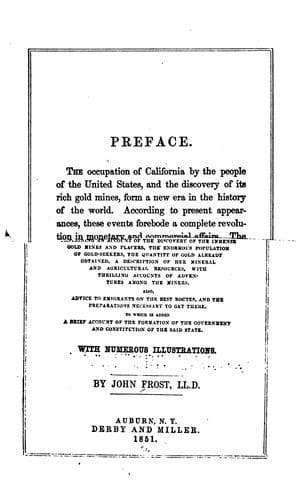
History of the State of California: From the Period of the Conquest by Spain to Her Occupation by the United States of AmericaFrost, John
History
History of the State of California: From the Period of the Conquest by Spain to Her Occupation by the United States of America
Frost, John
California -- Gold discoveries; California -- History
"At the close of the war with Mexico, it was supposed that there were,
including discharged volunteers, from ten to fifteen thousand
Americans and Californians, exclusive of converted Indians, in the
territory. The immigration of American citizens in 1849, up to the 1st
of January last, was estimated at eighty thousand--of foreigners,
twenty thousand.
"The population of California may, therefore, be safely set down at
115,000 at the commencement of the present year.
"It is quite impossible to form any thing like an accurate estimate of
the number of Indians in the territory. Since the commencement of the
war, and especially since the discovery of gold in the mountains,
their numbers at the missions, and in the valleys near the coast, have
very much diminished. In fact, the whole race seems to be rapidly
disappearing.
"The remains of a vast number of villages in all the valleys of the
Sierra Nevada, and among the foot-hills of that range of mountains,
show that at no distant day there must have been a numerous
population, where there is not now an Indian to be seen. There are a
few still retained in the service of the old Californians, but these
do not amount to more than a few thousand in the whole territory. It
is said there are large numbers of them in the mountains and valleys
about the head-waters of the San Joaquin, along the western base of
the Sierra, and in the northern part of the territory, and that they
are hostile. A number of Americans were killed by them during the last
summer, in attempting to penetrate high up the rivers in search of
gold; they also drove one or two parties from Trinity River. They
have, in several instances, attacked parties coming from or returning
to Oregon, in the section of country which the lamented Captain Warner
was examining when he was killed.
"It is quite impossible to form any estimate of the number of these
mountain Indians. Some suppose there are as many as three hundred
thousand in the territory, but I should not be inclined to believe
that there can be one-third of that number. It is quite evident that
they are hostile, and that they ought to be chastised for the murders
already committed.
"The small bands with whom I met, scattered through the lower portions
of the foot-hills of the Sierra, and in the valleys between them and
the coast, seemed to be almost the lowest grade of human beings. They
live chiefly on acorns, roots, insects, and the kernel of the pine
burr; occasionally, they catch fish and game. They use the bow and
arrow, but are said to be too lazy and effeminate to make successful
hunters. They do not appear to have the slightest inclination to
cultivate the soil, nor do they even attempt it--as far as I could
obtain information--except when they are induced to enter the service
of the white inhabitants. They have never pretended to hold any
interest in the soil, nor have they been treated by the Spanish or
American immigrants as possessing any.
Public-domain text, read in full here on John Shaqi.
Reviews
Reviews
No reviews yet
Be the first to share your thoughts on this work.
Elsewhere in the archive
Join the Discussion
Join the discussion
Sign in to leave a comment or review.
Sign InorCreate an account