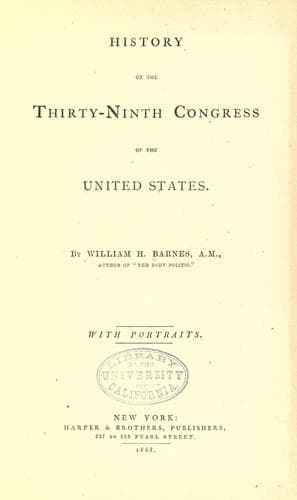
History of the Thirty-Ninth Congress of the United StatesBarnes, William Horatio
History
History of the Thirty-Ninth Congress of the United States
Barnes, William Horatio
United States -- Politics and government -- 1865-1869; United States. Congress (39th : 1865-1867)
"It was found, not a great while afterward, that the views which the
President entertained as to his duty were somewhat in conflict with
the provisions of this order; for it was held by the President that
persons who had brought themselves within the range of his pardon and
had secured it, and who had taken or did afterward take the amnesty
oath, would be entitled, as one of the results of the pardon and of
their position after the oath had been taken, to a restoration of
their lands which had been assigned to freedmen. In consequence of
this, an order was subsequently issued, well known as circular No. 15.
And under the operation of that circular, on its appearing
satisfactorily to any assistant commissioner that any property under
his control is not 'abandoned,' as defined in the law, and that the
United States have acquired no perfect right to it, it is to be
restored and the fact reported to the commissioner. 'Abandoned' lands
were to be restored to the owners pardoned by the President, by the
assistant commissioners, to whom applications for such restoration
were to be forwarded; and each application was to be accompanied by
the pardon of the President and by a copy of the oath of amnesty
prescribed in the President's proclamation, and also by a proof of
title to the land. It must be obvious that the effect of this must
have been to transfer from the care of the bureau to the owners very
large portions of the land which had been relied upon for the support
of the freedmen. Within a few weeks from the date of that order, no
less than $800,000 worth of property in New Orleans was transferred,
and about one third of the whole property in North Carolina in
possession of the bureau was given up; and the officer having charge
of the land department reports that before the end of the year, in all
probability, there will be under the charge of the commissioner
little, if any, of the lands originally designed for the support of
these freedmen.
"It is obvious, if these lands are to be taken, that other lands must
be provided, or the freedmen will become a dead weight upon the
Treasury, and the bill under consideration assigns other lands, in the
place of those thus taken, from the unoccupied public lands of the
United States."
On the following day, Mr. Dawson, of Pennsylvania, obtained the floor
in opposition to the bill. His speech was not devoted to a discussion
of the bill in question, but was occupied entirely with general
political and social topics. The following extract indicates the tenor
of the speech:
Public-domain text, read in full here on John Shaqi.
Reviews
Reviews
No reviews yet
Be the first to share your thoughts on this work.
Elsewhere in the archive
Join the Discussion
Join the discussion
Sign in to leave a comment or review.
Sign InorCreate an account