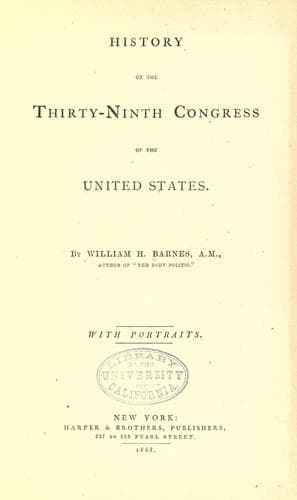
History of the Thirty-Ninth Congress of the United StatesBarnes, William Horatio
History
History of the Thirty-Ninth Congress of the United States
Barnes, William Horatio
United States -- Politics and government -- 1865-1869; United States. Congress (39th : 1865-1867)
After having quoted Gibbon's narrative of the destruction of the
colossal statue of Serapis by Theophilus, Mr. Garfield said: "So
slavery sat in our national Capitol. Its huge bulk filled the temple
of our liberty, touching it from side to side. Mr. Lincoln, on the 1st
of January, 1863, struck it on the cheek, and the faithless and
unbelieving among us expected to see the fabric of our institutions
dissolve into chaos because their idol had fallen. He struck it again;
Congress and the States repeated the blow, and its unsightly carcass
lies rotting in our streets. The sun shines in the heavens brighter
than before. Let us remove the carcass and leave not a vestige of the
monster. We shall never have done that until we have dared to come up
to the spirit of the Pilgrim covenant of 1620, and declare that all
men shall be consulted in regard to the disposition of their lives,
liberty, and property. The Pilgrim fathers proceeded on the doctrine
that every man was supposed to know best what he wanted, and had the
right to a voice in the disposition of himself."
Mr. Taylor, of New York, opposed the bill principally on the ground of
the expense involved in its execution. After having presented many
columns of figures, Mr. Taylor arrived at this conclusion: "The cost
or proximate cost of the bureau for one year, confining its operation
to the hitherto slave States, will be $25,251,600. That it is intended
to put the bureau in full operation in every county and parish of the
hitherto slave States, including Delaware, Maryland, Kentucky, and
Missouri, I have not the least doubt, nor have I any doubt but that it
is intended to extend it into parts of some of the border States."
Mr. Donnelly moved to amend the bill by inserting the provision that
"the commissioner may provide a common-school education for all
refugees and freedmen who shall apply therefor." He advocated
education as an efficient means of restoration for the South. He
presented ample tables of statistics, and summed up the results in
their bearing upon his argument as follows:
"The whole United States, with a population of 27,000,000, contains
834,106 illiterate persons, and of these 545,177 are found in the
Southern States with a population of 12,000,000. In other words, the
entire populous North contains but 288,923, while the sparsely-settled
South contains 545,177."
As an argument for the passage of the bill, he answered the question,
"What has the South done for the black man since the close of the
rebellion?"
Public-domain text, read in full here on John Shaqi.
Reviews
Reviews
No reviews yet
Be the first to share your thoughts on this work.
Elsewhere in the archive
Join the Discussion
Join the discussion
Sign in to leave a comment or review.
Sign InorCreate an account