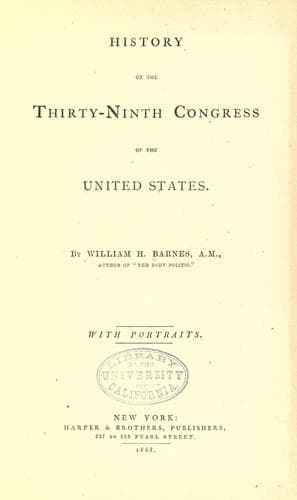
History of the Thirty-Ninth Congress of the United StatesBarnes, William Horatio
History
History of the Thirty-Ninth Congress of the United States
Barnes, William Horatio
United States -- Politics and government -- 1865-1869; United States. Congress (39th : 1865-1867)
He thus presented his calculation of the cost of carrying out the bill
as an argument against it: "In 1822 the ordinary expenses of the
Government were $9,827,643, and in 1823 the expenses amounted to the
sum of $9,784,154. Now, sir, who could have thought at that day that
in the comparatively short time of forty-three years it would require
the sum of even $12,000,000 to fix up a machinery alone for the
benefit of three or four million negroes, and more especially, sir,
when it is understood that in 1820 we had a population, including
white and colored, of 9,633,545. Mr. Speaker, how long will it be at
this rate--when we take into consideration the fact that our
Government proper, besides this little bureau machine, is now costing
us hundreds of millions of dollars--how long, sir, will it be before
we have to call in the services of Mr. Kennedy, of census notoriety,
to estimate the amount of the debt we owe?"
Mr. Rousseau, of Kentucky, in defining his position, said: "I am not a
Republican; I was a Whig and a Union man, and belong to the Union
party, and I am sorry to say that the Union party and the Republican
party are not always convertible terms."
Mr. Rousseau urged, against the Freedmen's Bureau Bill the wrongs and
oppressions which its abuses heaped upon the people of the South. In
the course of his speech Mr. Rousseau quoted what he had said on one
occasion to an official of the Freedmen's Bureau: "I said to him, 'if
you intend to arrest white people on the _ex parte_ statements of
negroes, and hold them to suit your convenience for trial, and fine
and imprison them, then I say that I oppose you; and if you should so
arrest and punish me, I would kill you when you set me at liberty; and
I think that you would do the same to a man who would treat you in
that way, if you are the man I think you are, and the man you ought to
be to fill your position here.'"
Public-domain text, read in full here on John Shaqi.
Reviews
Reviews
No reviews yet
Be the first to share your thoughts on this work.
Elsewhere in the archive
Join the Discussion
Join the discussion
Sign in to leave a comment or review.
Sign InorCreate an account