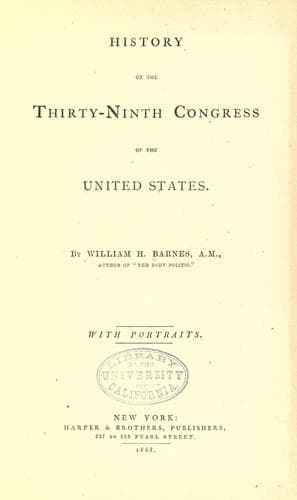
History of the Thirty-Ninth Congress of the United StatesBarnes, William Horatio
History
History of the Thirty-Ninth Congress of the United States
Barnes, William Horatio
United States -- Politics and government -- 1865-1869; United States. Congress (39th : 1865-1867)
Mr. Trumbull said: "I wish to say upon that point that the bill as it
passed the Senate can have no operation except in regions of country
where there are refugees and freedmen. It is confined to those
districts of country, and it could not have operation in most of the
loyal States. But it is desirable, as I am informed, and it was so
stated by one of the Senators from Maryland, that the operations of
this bill should be extended to Maryland. It may be necessary that it
should be extended to Missouri, and possibly to Delaware. I trust not;
but the authority to extend it there ought to exist, if there should
be occasion for it. The only objection I have to limiting the
operation of the bill to the late slaveholding States is, that I think
it bad legislation, when we are endeavoring to break down
discrimination and distinction, to pass a law which is to operate in
one State of the Union and not in another. I would rather that the law
should be general, although I am fully aware that there is nothing for
the law to operate upon in most of the States of the Union. I do not
feel quite willing to vote upon Kentucky, for instance, a law that I
am not willing to have applicable to the State of Illinois, if such a
state of facts exists as that the law can operate in Illinois. I
prefer, therefore, to have the bill in the shape in which it passed
the Senate, and such was the opinion of the Committee on the
Judiciary."
Mr. Guthrie, of Kentucky, spoke with much feeling upon the bearings of
the bureau upon his State: "You will have to acknowledge these States
or you will have to do worse. The passage of this system of bills is a
dissolution of the Union, and you can not help it. It will be
impossible for you to carry on this Government under any such system.
When the Union is not to be restored, when there is nothing of that
feeling to make the people endure, do you suppose they will endure
forever? Do you suppose this bill will attach the people in these
eleven States more thoroughly to the Union than they felt when they
reoerganized their State governments, passed laws manumitting their
slaves, electing their Legislatures, and doing all that was indicated
as necessary to be done? Do you suppose that there will ever come a
time, under this bill, that they will desire to become members of this
Union once more? I see in this bill exactly how Kentucky is tolerated
here; for as to having part in this legislation, when she is charged
openly with being ruled at home by rebels, our counsels can be of no
good here; but still we are not to be driven from the Union, and from
raising our voice in favor of it, and raising it in favor of
conciliation and confidence from one section to the other. Gentlemen
do not get these doctrines of hatred and vengeance from the Gospel.
These are not the doctrines taught by the Savior of the world. While
you cry for justice to the African, you are not slow to commit wrong
and outrage on the white race.
Public-domain text, read in full here on John Shaqi.
Reviews
Reviews
No reviews yet
Be the first to share your thoughts on this work.
Elsewhere in the archive
Join the Discussion
Join the discussion
Sign in to leave a comment or review.
Sign InorCreate an account