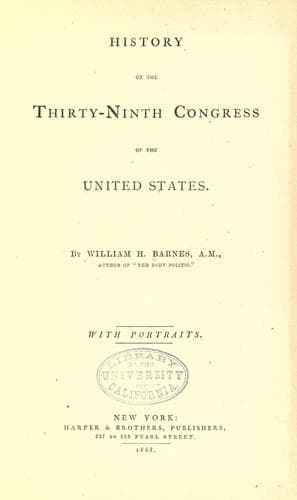
History of the Thirty-Ninth Congress of the United StatesBarnes, William Horatio
History
History of the Thirty-Ninth Congress of the United States
Barnes, William Horatio
United States -- Politics and government -- 1865-1869; United States. Congress (39th : 1865-1867)
"But, sir, what is the objection to it if it did appropriate the
money? I have already undertaken to show, and I think I have shown,
that it was the duty of the United States, as an independent nation,
as one of the powers of the earth, whenever there came into its
possession an unprotected class of people, who must suffer and perish
but for its care, to provide for and take care of them. When an army
is marching through an enemy's country, and poor and destitute persons
are found within its lines who must die by starvation if they are not
fed from the supplies of the army, will any body show me the
constitutional provision or the act of Congress that authorizes the
general commanding to open his commissariat and feed the starving
multitude? And has it not been done by every one of your commanders
all through the South? Whenever a starving human being, man, woman, or
child, no matter whether black or white, rebel or loyal, came within
the lines of the army, to perish and die unless fed from our supplies,
there has never been an officer in our service, and, thank God! there
has not been, who did not relieve the sufferer. If you want to know
where the constitutional power to do this is, and where the law is, I
answer, it is in that common humanity that belongs to every man fit to
bear the name, and it is in that power that belongs to us as a
Christian nation, carrying on war upon civilized principles.
"If we had the right then to feed those people as we did, have we not
the right to take care of them in the cheapest way we can? If, when
General Sherman was passing through Georgia, he found the lands
abandoned; if their able-bodied owners had entered the rebel army to
fight against us; if the women and children had fled and left the land
a waste, and he had, as is the fact, thousands of persons hanging upon
his army dependent upon him for supplies; if it was believed that it
would be cheaper to support these people upon these lands than to buy
provisions to feed them, might we not do so? May we not resort to
whatever means is most judicious to protect from starvation that
multitude which common humanity requires us to feed?
"Nor, sir, is it true that no provision has been made by Congress for
the education of white people. We have given all through the new
States one section of land in every township for the benefit of common
schools. We have donated hundreds of thousands of acres of land to all
the States for the establishment of colleges and seminaries of
learning. How did we get this land? It was purchased by our money, and
then we gave it away for purposes of education. The same right exists
now to provide for these people, and it is not simply for the black
people, but for the white refugees as well as the black, that this
bill provides."
Public-domain text, read in full here on John Shaqi.
Reviews
Reviews
No reviews yet
Be the first to share your thoughts on this work.
Elsewhere in the archive
Join the Discussion
Join the discussion
Sign in to leave a comment or review.
Sign InorCreate an account