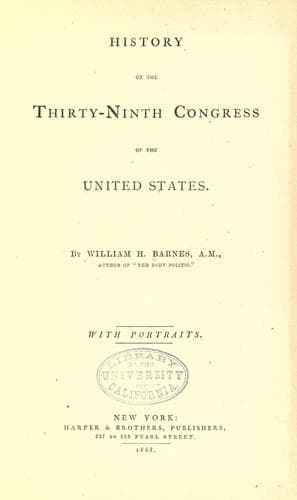
History of the Thirty-Ninth Congress of the United StatesBarnes, William Horatio
History
History of the Thirty-Ninth Congress of the United States
Barnes, William Horatio
United States -- Politics and government -- 1865-1869; United States. Congress (39th : 1865-1867)
The bill declares that "there shall be no discrimination in civil
rights or immunities among the inhabitants of any State or Territory
of the United States on account of race, color, or previous condition
of slavery; but the inhabitants, of every race and color, without
regard to any previous condition of slavery or involuntary servitude,
except as a punishment for crime whereof the party shall have been
duly convicted, shall have the same right to make and enforce
contracts, to sue, be parties, and give evidence, to inherit,
purchase, lease, sell, hold, and convey real and personal property,
and to full and equal benefit of all laws and proceedings for the
security of person and property, and shall be subject to like
punishment, pains, and penalties, and to none other, any law, statute,
ordinance, regulation, or custom to the contrary notwithstanding. Any
person who, under cover of any law, statute, ordinance, regulation, or
custom, shall subject, or cause to be subjected, any inhabitant of any
State or Territory to the deprivation of any right secured or
protected by the act, or to different punishment, pains, or penalties,
on account of such person having at any time been held in a condition
of slavery or involuntary servitude, except as a punishment for crime
whereof the party shall have been duly convicted, or by reason of his
color or race, than is prescribed for the punishment of white persons,
is to be deemed guilty of a misdemeanor, and, on conviction, to be
punished by a fine not exceeding $1,000, or imprisonment not exceeding
one year, or both, in the discretion of the court."
Other provisions of the bill relate to the courts which shall have
jurisdiction of cases which arise under the act, and the means to be
employed in its enforcement.
That no question might arise as to the constitutionality of the law,
all the provisions which relate to the enforcement of the act were
borrowed from the celebrated Fugitive Slave Law, enacted in 1850. It
was a happy thought to compel the enemies of the negro themselves, as
judges, to pronounce in favor of the constitutionality of this
ordinance. It is an admirable illustration of the progress of the age,
that the very instruments which were used a few years before to rivet
tighter the chains of the slave, should be employed to break those
very chains to fragments. It shall forever stand forth to the honor of
American legislation that it attained to more than poetic justice in
using the very means once employed to repress and crush the negro for
his defense and elevation.
Within less than a week after the reference of this bill to the
Judiciary Committee, it was reported back, with no alteration save a
few verbal amendments. On account of pressure of other business, it
did not come up for formal consideration and discussion in the Senate
until the 29th of January. On that day Mr. Trumbull, having called up
the bill for the consideration of the Senate, said:
Public-domain text, read in full here on John Shaqi.
Reviews
Reviews
No reviews yet
Be the first to share your thoughts on this work.
Elsewhere in the archive
Join the Discussion
Join the discussion
Sign in to leave a comment or review.
Sign InorCreate an account