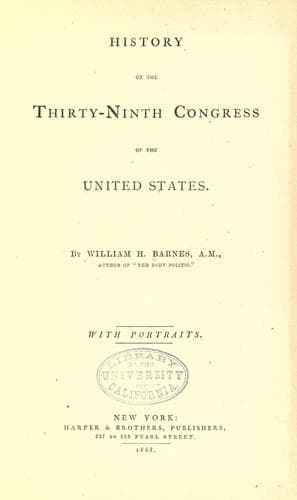
History of the Thirty-Ninth Congress of the United StatesBarnes, William Horatio
History
History of the Thirty-Ninth Congress of the United States
Barnes, William Horatio
United States -- Politics and government -- 1865-1869; United States. Congress (39th : 1865-1867)
In alluding to Mr. Johnson's strictures on his assertion that Congress
had no power to confer the right of citizenship on "the native born
negro," Mr. Davis said: "The honorable Senator, [Mr. Johnson,] as I
said the other day, is one of the ablest lawyers, and, I believe, the
ablest living lawyer in the land. I have seen gentlemen sometimes so
much the lawyer that they had to abate some of the statesman
[laughter]; and I am not certain, I would not say it was so--I will
not arrogate to myself to say so--but sometimes a suspicion flashes
across my mind that that is precisely the predicament of my honorable
friend.
"I maintain that a negro can not be made a citizen by Congress; he can
not be made a citizen by any naturalization laws, because the
naturalization laws apply to foreigners alone. No man can shake the
legal truth of that position. They apply to foreigners alone; and a
negro, an Indian, or any other person born within the United States,
not being a foreigner, can not be naturalized; therefore they can not
be made citizens by the uniform rule established by Congress under the
Constitution, and there is no other rule. Congress has no power, as I
said before, to naturalize a citizen. They could not be made citizens
by treaty. If they are made so at all, it is by their birth, and the
locality of their birth, and the general operation and effect of our
Constitution. If they are so made citizens, that question is a
judicial question, not a legislative question. Congress has no power
to enlarge or extend any of the provisions of the Constitution which
bear upon the birth or citizenship of negroes or Indians born in the
United States.
"If there was any despot in Europe or in the world that wanted a
master architect in framing and putting together a despotic and
oppressive law, I would, if my slight voice could reach him, by all
means say to him, Seek the laboratory of the Senator from Illinois. If
he has not proved himself an adept in this kind of legislation,
unconstitutional, unjust, oppressive, iniquitous, unwise, impolitic,
calculated to keep forever a severance of the Union, to exclude from
all their constitutional rights, privileges, and powers under the
Government eleven States of the Union--if he has not devised such a
measure as that, I have not reason enough to comprehend it."
Public-domain text, read in full here on John Shaqi.
Reviews
Reviews
No reviews yet
Be the first to share your thoughts on this work.
Elsewhere in the archive
Join the Discussion
Join the discussion
Sign in to leave a comment or review.
Sign InorCreate an account