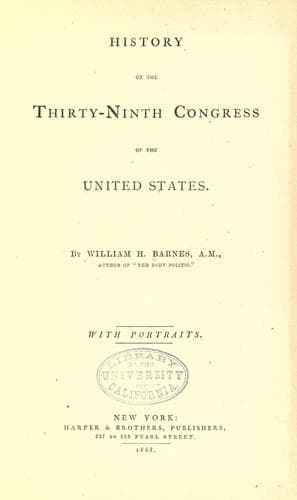
History of the Thirty-Ninth Congress of the United StatesBarnes, William Horatio
History
History of the Thirty-Ninth Congress of the United States
Barnes, William Horatio
United States -- Politics and government -- 1865-1869; United States. Congress (39th : 1865-1867)
"Kentucky has had her share of talking here, and, sir, she has had her
share of suffering during the war. At one time she was invaded by
three armies of the rebellion; all but seven or eight counties of the
State, at one time, were occupied by its armies, and her whole
territory devastated by guerrillas. We have suffered in this war. We
have borne it as best we could. We feel it intensely that now, at the
end of the war, we should be subjected to a military despotism, our
houses liable to be entered at any time when our families are at rest,
by military men who can arrest and send to prison without warrant, and
we are obliged to go, and we are obliged to pay any fines they may
impose. I do not believe that you will lose any thing if you pause
before passing such legislation as this, and establishing these
military despotisms, for we do not know where they are to end."
Mr. Hendricks, of Indiana, had proposed to strike out the last clause
of the bill, which provided that "such part of the land and naval
forces of the United States, or of the militia," as should be
necessary, might be employed to prevent the violation, and enforce the
due execution of this act. The Senator from Indiana opposed the bill
on the ground that it employed the machinery of the Fugitive Slave
Law, and that it was to be enforced by the military authority of the
United States. He said:
"This bill is a wasp; its sting is in its tail. Sir, what is this
bill? It provides, in the first place, that the civil rights of all
men, without regard to color, shall be equal; and, in the second
place, that if any man shall violate that principle by his conduct, he
shall be responsible to the court; that he may be prosecuted
criminally and punished for the crime, or he may be sued in a civil
action and damages recovered by the party wronged. Is not that broad
enough? Do Senators want to go further than this? To recognize the
civil rights of the colored people as equal to the civil rights of the
white people, I understand to be as far as Senators desire to go; in
the language of the Senator from Massachusetts [Mr. Sumner], to place
all men upon an equality before the law; and that is proposed in
regard to their civil rights."
Public-domain text, read in full here on John Shaqi.
Reviews
Reviews
No reviews yet
Be the first to share your thoughts on this work.
Elsewhere in the archive
Join the Discussion
Join the discussion
Sign in to leave a comment or review.
Sign InorCreate an account